Four ancient bodies have been excavated in a Lima, Peru neighborhood. They were wrapped in textiles and facing the sea. They were buried in separate tombs. They belonged to the Ichma culture which dates to 1000 -1440 CE. Some of the skeletons still have hair. They were buried with ceramic pots and weaving tools. There are 350 ancient ceremonial complexes in Lima. Sixteen were built by the Ichma culture. The four bodies were found at the site of Huaca Pucllana. Archaeologists are expecting to find more tombs at the site.
New Important Discoveries at Zultépec-Tecoaque in Tlaxcala
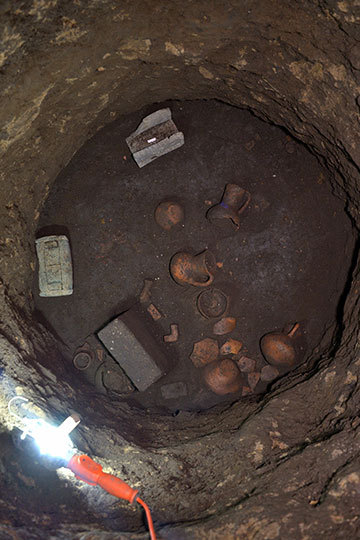
A new discovery has been made at the Zultépec-Tecoaque archaeological site in Tlaxcala. INAH has found the skeleton of a high ranking Acolhua leader in a cistern, a full size throne made of volcanic rock, and a carved stone with the pictograph of Ometochtli or “Two Rabbit.” The site dates to 1200-1521 CE. The glyph of Two Rabbit is associated with pulque. Pulque was produced in this area. The buried individual was 25 years old. They have also found a cistern with the bones of three different infants that had been cooked or boiled and possibly eaten.
Earlier report I posted on surprising finds at this site;
Decapitated Spaniards from 1520 Convoy Uncovered at the site of Zultepec-Tecoaque
In 1520 CE, the Alcohua town of Zultepec-Tecoaque captured a supply convoy of 15 Spaniards and 45 food soldiers of Cuban and African descent, women and 350 Indian allies a year after the conquest of Tenochtitlan. The townspeople carved clay figurines of the captives, and sumbolically decapitated the figurines. The captives were then sacrificed and eaten. The captives were held in cells for six months and then all were slowly canibalized, to ask the gods for protection from them. The pigs the Spaniards brought were left uneaten. These would have been strange creatures to the invaded. The captives were torn apart and the meat removed from their bones. One woman was found dismembered with the skull of a one year old placed in her pelvis. Spanish valuables like majolica china, jewelry, spurs, stirrups were tossed into wells. A horse’s rib bone was carved into a musical instrument. The heads of the captives were placed on a skull rack. Cortes dispatched a punitive expedition. The townspeople then hid all of the remains of the Spaniards, which has allowed archaeologists to find the remains.
Tom Dillehay, the archaeologist who excavated the first proven Pre-Clovis site in the Americas, Monte Verde, Chile has just published results of his latest excavations at the site. He has uncovered artifacts with burned features that are dated to 16,500 BCE. He found burned faunal remains, worked stones, and human knapped flakes that date to 16,500-12-500 BCE. The site is a seasonal site where humans periodically camped. The idea that humans spread rapidly from established sites across the Americas is now in question. Coastal travel for the First Americans was probably easy, but moving inland may have had many difficulties. The earliest human skulls found in the Americas are surprisingly variable, and the earliest populations may have been largely wiped out by later arrivers. The traces of the earliest people may have been found in recent gentic studies in modern South American populations.
Forensic geneticists have sequenced the DNA of a frozen seven year old Inca boy mummy. He was found to have originated far to the north in the Peruvian Andes and belonged to a genetic sub-group of unidentified Paleo-Indians. He was sacrificed 500 years ago in the Inca capacocha ritual, where perfectly unblemished children were offered to the gods by drugging them and letting them freeze in the high mountains. He was found in 1985. He was wrapped in textiles and buried with six statuettes. It is believed his group dates to 12,300 BCE. The genetic lineage of the child is almost extinct today, but his line would have been more frequent in Inca times.
The Daily Mail has the story here with their usual excellent photos and a short video from NatGeo showing another Inca child mummy, a girl, being studied. The preservation is remarkable. http://dailym.ai/1N0NFH5
Science Magazine adds that “they will map the complete nuclear genome of the Aconcagua boy and to sequence the DNA of all the microbes preserved in the mummy’s gut, including his microbiome and any infectious germs he might have been carrying. That could help scientists understand how microorganisms—both the ones that hurt us and the ones that help us—have evolved over time. Wilson hopes similar studies can be done on other capacocha mummies.” http://news.sciencemag.org/archaeology/2015/11/inca-child-mummy-reveals-lost-genetic-history-south-america
The site of Ceren in El Salvador is the best preserved site in Latin America due to its being covered by volcanic ash in 660 CE. The preservation is so great, finger swipes on ceramic bowls and footprints in gardens, bean-filled pots, woven blankets have been found there. The villagers there had freedom in their architecture, crops, rituals, economics. 200 people lived there. 12 buildings have been excavated, including storehouses and workshops. No bodies have been found, perhaps because the villagers may have left at a precursor earthquake, before the volcanic eruption. The villagers traded crops and crafts for jade axes for tool use, polychrome pots, obsidian knives at a public market. There appears to have been a crop harvest festival ongoing when disaster struck. They probably fled on a raised sacbe. White Sacbes were only known in the Yucatan until the discovery of the one at Ceren. Researchers are studying the sacbe for the signs of the exodus south. It appears the sacbe was constructed in family work units supervised by elders. Some households maintained a wood supply for the sweat bath for the community sauna building. Lead archaeologist Payson Sheets found manioc fields at Ceren. The only place intensive manioc cultivation was ever found. It was used for tortillas, tamales, and alcoholic beverages. The work has been funded by the University of Colorado at Boulder, National Geographic Society, the Smithsonian Institution, the Getty Conservation Institute and a number of universities.
9000 Ancient Artifacts Uncovered in the Mojave Desert
Archaeologists have found 9,000 artifacts representing 11,500 years of history. 8,830 stone tools, flakes, ceramics, bone and a Clovis blade made from jasper have been uncovered in the Mojave desert. They also perused older research reports from this area, which is on a Marine base. 19 Western Stemmed Tradition points and 14 Pinto points had been found in the area, dating to 4000-6,500 BCE. Most of the artifacts uncovered by this team date to 5000-7000 BCE. The team has requested that the two most productive sites be placed on the Department of the Interior’s National Register of Historic Places. Byerly and his colleagues report their findings in the journal Paleoamerica. Byerly, R., & Roberson, J. (2015). Late Pleistocene to Middle Holocene Archaeology in the Mojave Desert: Recent Discoveries in Twentynine Palms, California PaleoAmerica, 1 (2), 197-201 DOI: 10.1179/2055556315Z.00000000020
Twelve human trophy heads and one feline trophy head have been found in a cemetery in Peru. The area is dated to 600-1100 CE. The heads were skinned and drilled with holes for cords. The feline head had its eyes stuffed with red textiles. Feline trophy heads are seen on pottery, but this now proves that the representations are real. Both Nazca and Wari style trophy heads were found, based on skull perforation styles. The heads were probably attached to headdresses or worn as masks in ritual performances. Isotopic analysis is now taking place. For more information on the project; www.experiment.com/trophyskulls.




 MIKE RUGGERI'S ANCIENT AMERICAS NEWS