January 30, 2016

2,500 Years Old Footprints Found in Tucson

Archaeologists have found footprints of a family of farmers embedded in the soil at a site in Tucson dating to 500 BCE, making these the oldest footprints ever found in the Southwest. A flash flood at the time had covered these prints over, preserving them. The farmers were ancestors of the Hohokam culture who built elaborate irrigation canals. The Hohokam grew cotton, tobacco, maize, beans and squash. The footprints show adults, children and a family pet walking across their fields. They are making 3D scanning videos of the prints and casts of the footprints before they are covered over to build a highway. The site also shows evidence of irrigation canals and earthworks. The prints show the farmers moving from canal gate to canal gate and building mud dams to divert rain and river water to maize plants. Archaeologists will now study the soil nearby for futher evidence of these early farmers.

(My note; Footprints dated at more than 13,000 years ago have been found on an island off of British Columbia, and Tom Dillehay found human footprints at the site of Monte Verde in Chile that date to 1000 years before Clovis times. These are the first Pre-Clovis footprints found so far. The dates for these prints have been validated by all other researchers who have come to the site to verify the find.)

Daily Mail has the report here with many videos, 3D Scans and great photos;
http://dailym.ai/1ZV2lIE

Mike Ruggeri’s Ancient Southwest/Mound Builders News Magazine
http://bit.ly/16PP9jH
January 27, 2016

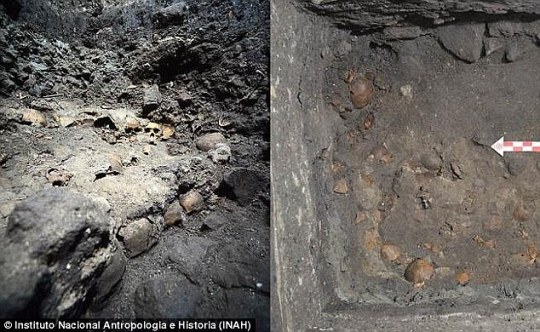
A New INAH Study on Human Sacrifice at Tenochtitlan

A new study by INAH of who was sacrificed at Tenochtitlan shows that many of the sacrificed were Mexica from the area and not all war captives from further afield. The skulls and teeth of six individuals who were sacrificed at the Great Temple of Tenochtitlan were studied. They were individuals who lived under the reign of Moctezuma II. The individuals studied were probably servants for the elite, and had lived at Tenochtitlan for at least six years. The article also mentions the recent finds of Aztec skull racks at the Great Temple which proves the assertions made in primary sources about the existence of these skull racks. A surprising find among these skull racks is one that has the skulls of the sacrificed mortared together into a circle, with all of the heads facing inward into a space. This find was a total surprise.

The Daily Meal has their usual great illustrated report on this discovery;
http://www.dailymail.co.uk/sciencetech/article-3417150/Did-Aztec-rulers-sacrifice-STAFF-Bones-reveals-victims-served-elite-killed-Great-Temple-Tenochtitl-n.html

Mike Ruggeri’s Toltecs and Aztecs
http://mikeruggeristoltecsandaztecs.tumblr.com

Mike Ruggeri’s Aztec and Toltec World Magazine
http://bit.ly/1ygAdbd

January 26, 2016

Unusual Lambayeque Culture Female Sacrifices Uncovered

Archaeologists have found the bodies of six women ritually killed at 800 CE in the Pucala District of Peru in a secret compound of the Huaca Santa Rosa temple. The women were buried with a llama and ceramics. They were placed facing the Andes. They would have been killed in ceremonies that involved ritual costumes and drinking the victim’s blood. They were part of the Lambayeque (Sican) Culture (750-1375 CE). The women appear go have been taken as slaves or captured from other Pre-Inca Cultures.

The Daily Mail has their usual excellent photo collection of the site and a video as well;
http://dailym.ai/1nm168R

Mike Ruggeri’s Ancient Andean World
http://bit.ly/VD1spm

January 23, 2016

Ancient Weaver Remains Found in Lima

Archaeologists have uncovered the remains of a presumed weaver in the Huaca El Paraiso in Lima. The remains and weaving materials the remains were found with date to 1500 BCE. Textile instruments and products not from the coast indicate wider trading. Clay figurines similar to those found at Caral were also found.

Peru This Week has the report;
http://bit.ly/1PctoNV

Mike Ruggeri’s Ancient Andean World
http://bit.ly/VD1spm

January 15, 2016

Genetic Proof for First Americans Disproves any Trans-Atlantic Migrations.

Professors Jennifer Raff and Deborah Bolnick has written report for the journal PaleoAmerica on the First Americans. She points out that all of the genetic data from mitochondrial and genomic material gathered thus far on who they were points to migrations from Siberia, and does not show evidence of any Trans-Atlantic migrations. The Solutrean hypothesis about early migrations from Europe are not supported by any solid genetic data. The argument made about the X2a haplogroup found in Kennewick Man being of European origin  is put to rest by the recent more complete study showing Kennewick Man had no proof of any European ancestry through his entire genome.

(My note; The haplogroup referred to is found in the Altaic region of Siberia as well as Europe. The rest of the genomes in any study like this will tell the origins of the First Americans. And all of that evidence shows an Asiatic origin, coming right down to the genetic studies of modern Native Americans).

PhysOrg has the report here;
http://phys.org/news/2016-01-genetic-ancient-trans-atlantic-migration-professor.html

Mike Ruggeri’s Pre-Clovis and Clovis News on Tumblr
http://mikeruggerispreclovisnews.tumblr.com

Mike Ruggeri’s Pre-Clovis and Clovis World Magazine
http://bit.ly/1uAWdvk

January 13, 2016

A New important Maya related site excavated in Honduras

A Maya site in Honduras is under excavation in the jungle of La Mosquitia by a joint American/Honduran team..  A large number of artifacts have been uncovered. 64 stone artifacts have been uncovered so far at the base of a pyramid. They are mostly stone jars and metates decorated with animal heads and geometric patterns. The culture that resided here is an unknown one. Honduran President Hernanez was allowed to remove a “were-jaguar” head that was part of a metate with legs and a stubby tail. As a result of this artifact, the area of the site is now called the “Valley of the Jaguar.” The area is in a pristine tropical wilderness far from any human habitation. Earlier reports criticized this find as a previously discovered site, but the Honduras archaeological experts are stating this is a pristine site. There is a larger site nearby to be excavated by the same team.

National Geographic has the report here;
http://news.nationalgeographic.com/2016/01/160113-honudran-lost-city-archaeology/

Mike Ruggeri’s Ancient Maya News on Tumblr
http://mikeruggerisacientmayanew.tumblr.com

Mike Ruggeri’s Ancient Maya News Magazine
http://bit.ly/1CeeXyu


January 8, 2016

A Pax Hohokam Culture?

Archaeologist Steven Shackley at the UC Berkeley has done an analysis of spear and arrow points in the Hohokam region, and chemically analyzed thousands of obsidian pieces to find their origins. He has concluded that the style of the projectile points, ceramics, burial practices, rock art, tools and origin stories are Hohokam as far north as Colorado, Flagstaff, into New Mexico and California and down into Baja. The material connection to the Hohokam throughout this entire area is strong over 50,000 square miles. From 700-1300 CE, there is little evidence of large scale violence in this area. The Hohokam were a diverse multiethnic, multilingual society. Shackley’s analysis will be a point of controversy and debate as archaeologists continue to expand our knowledge of the entire ancient Southwest.

The Payson Roundup has the report here;
http://www.paysonroundup.com/news/2015/dec/30/how-far-did-hohokam-reach/

Mike Ruggeri’s
The Ancient Southwest
http://bit.ly/X1kCou

January 5, 2016

Inca Khipus Translation Breakthrough

Researchers have found a storage house for agricultural products 100 miles south of Lima at the Inca site of Incahuasi. They kept records on peanuts, chilis, beans, corn etc. there. Khipus were found under the produce, preserved in the dry desert climate. The Khipus are made of cotton or wool strings with knots, and they are dyed different colors. With this new discovery, which is the first time Khipus have been found with produce like this, it may allow the researchers to identify colors and knots related to each product, thus begin to translate khipus. The site was a place where llama caravans with farm produce would have been going through. The food was probably for Inca armies invading southward. More could be found at the site, but money for further research has run out there.

The NY Times has the report here;
http://mobile.nytimes.com/2016/01/03/world/americas/untangling-an-accounting-tool-and-an-ancient-incan-mystery.html

Mike Ruggeri’s Ancient Andean World
http://bit.ly/VD1spm