February 24, 2017

A Remarkable Maya Jade Pendant from Belize

A remarkable jade pendant was uncovered at the Maya site of Nim Li Punit in Belize in 2015. The archaeologist who found it has published a paper in Ancient Mesoamerica on the find and a second paper in the Journal of Field Archaeology about the excavations. It is the only jade pendant inscribed with a historical text. Nim Li Punit was inhabited between 150-850 CE. While excavating a palace there dated at 400 CE, they found a tomb dating to 800 CE. Inside were 25 pottery vessels, a carved stone representing a deity and the jade pectoral. The pendant is in the shape of a T and the front is carved with a T. This is the Maya glyph for “ik.” It stands for wind or breath. It was found in a T-shaped platform. And one of the vessels depicts a Maya god of wind. The inscription on the back says the pendant was first used in 672 CE. Two bas relief slabs at the site show kings wearing the pendant while scattering incense, carved in 721 and 731 CE. The pendant was buried in 800 CE. At this date, the Maya world began to crumble in Belize and Guatemala. The glyphs show the pendant was made for the Maya king Janaab’ Ohl K’inich. His mother was from the Belize site of Cahal Pech and the father probably came from Guatemala. The glyph story may link the king to the huge site of Caracol in Belize. Perhaps royalty arrived at the site with this pendant.

More excavations will continue.

Archaeology News Network has the story here;
http://bit.ly/2kVpa6a

Mike Ruggeri’s Maya World
http://bit.ly/MoAHNA

Mike Ruggeri’s Ancient Maya News Magazine
http://bit.ly/1CeeXyu

Mike Ruggeri’s Ancient Maya News on Tumblr
http://mikeruggerisacientmayanew.tumblr.com

February 23, 2017

Radiocarbon dating and DNA show ancient Puebloan leadership in the maternal line

Researchers have found that the Chaco Canyon elite in New Mexico descend from a matrilinear dynasty. Researchers used DNA studies and radio carbon data to investigate the first elite tomb at the Pueblo Bonito structure at Chaco. The initial burial was of a male in his late 40s who died from a blow to his head. He was buried with 1,000 turquoise beads, 3,300 shell beads and other artifacts including abalone shells and a conch shell trumpet originating from the Pacific Ocean and Gulf of California. This is the richest burial ever found in the Southwest. 12 more burials, spanning 300 years, were found on a floor above. All of the buried shared the same mitochrondial DNA, so inheritance was through the mother. So one kinship group controlled Pueblo Bonito for more than 300 years,
Douglas J. Kennett et al, Archaeogenomic evidence reveals prehistoric matrilineal dynasty, Nature Communications (2017).  DOI: 10.1038/ncomms14115

Phys.org  has the report here;
https://phys.org/news/2017-02-radiocarbon-dating-dna-ancient-puebloan.html

Mike Ruggeri’s
The Ancient Southwest
http://bit.ly/X1kCou

Mike Ruggeri’s Ancient Southwest Magazine
http://bit.ly/1AU3vwE

Mike Ruggeri’s Ancient Southwest/Mound Builders News Magazine
http://bit.ly/16PP9jH

Mike Ruggeri’s Moundbuilders/Ancient Southwest News on Tumblr
http://mikeruggerisancientnorthamerica.tumblr.com

February 23, 2017

New Research Discoveries in the Chaco Canyon, New Mexico

Researchers at Chaco have analyzed 60 sets of human remains at the Chaco site in New Mexico. The remains were found at the Pueblo Bonito structure of the site. These were elite burials with turquoise, pendants and pottery found in the graves. The researchers found that the vast majority were from Chaco Canyon, and not from more distant areas as many experts thought. So the Chaco phenomenon was brought about by the original settlers in the area. Isotope analysis was done on the teeth of these remains, which are scattered in museums throughout the US. The researchers found that the population of the elite was very homogeneous. There were 3 outliers that still have to be studied further to see where they may have come from among the 61 studied. The remains also exhibit cranial deformation, a sign of elite status throughout the Americas.
The team reports their findings in The Journal of Archaeological Science: Reports.
Price, T., Plog, S., LeBlanc, S., & Krigbaum, J. (2017). Great House origins and population stability at Pueblo Bonito, Chaco Canyon, New Mexico: The isotopic evidence Journal of Archaeological Science: Reports, 11, 261-273 DOI: 10.1016/j.jasrep.2016.11.043

Western Digs has the report here;
http://westerndigs.org/chacos-elites-were-native-to-the-canyon-not-migrants-their-remains-show/

Mike Ruggeri’s
The Ancient Southwest
http://bit.ly/X1kCou

Mike Ruggeri’s Ancient Southwest Magazine
http://bit.ly/1AU3vwE

Mike Ruggeri’s Ancient Southwest/Mound Builders News Magazine
http://bit.ly/16PP9jH

Mike Ruggeri’s Moundbuilders/Ancient Southwest News on Tumblr
http://mikeruggerisancientnorthamerica.tumblr.com

February 11, 2017

New Research into the Rise and Fall of Cahokia

Researchers at Cahokia had theorized that the large Mississippian sites, including Cahokia, began to build during an unusually warm period and began to decline during the Little Ice Age. New research on ancient layers of calcite crystals in layers of mud in an Indiana lake show that the Mississippi Valley began to get more rain in the 10th century, when corn began to thrive at around 950 CE, as shown in the skeletal remains at the time. Cahokia began to explode with growth at the time. Around 1200 CE, a new Ice Age began with drought at 1350 CE. This lasted for 500 years. Large conflicts began at 1250 CE, with more palisades being built, burned villages, more skeletal injuries like decapitation. Mississippians began to abandon their cities and moved south. A contributing factor would have been in-migration of different groups into the large centers like Cahokia in the good times. When the droughts began, migrant infighting may have also contributed to the collapse.

NPR has the story here;
http://n.pr/2kAkzV6

Mike Ruggeri’s Mississippians and Mound Builders
http://bit.ly/XX6RGc

Mike Ruggeri’s Ancient Mississippian World Magazine
http://bit.ly/1EhnzvE

Mike Ruggeri’s Ancient Mississippian Art, Religion, and Iconography Magazine
http://bit.ly/1zHFCGw

February 8, 2017

Ancient Colima Tomb Find

INAH has found a large ancient Colima tomb with the skeletal remains of at least 12 male individuals buried at 300 CE. Several have cranial deformation, and the teeth show they had severe dental problems. Several grave offerings were found, including two anthropomorphic sculptures. They are in the traditional Colima art style. This find is an unusual non-looted tomb in the area of the city of Colima.

INAH has the report with a photo here (in Spanish);
http://bit.ly/2k4n1QA

Mike Ruggeri’s Ancient West Mexico
http://mikeruggerisancientwestmexico.tumblr.com

Mike Ruggeri’s Ancient West Mexico Magazine
http://bit.ly/1zHJhUX

February 8, 2017

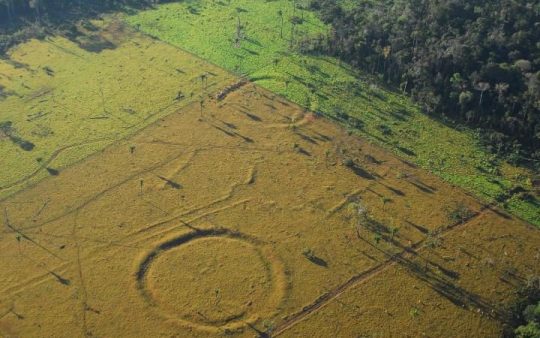
450 Ancient Stonehenge Type Enclosures Found in the Brazilian Amazon

450 ancient earthworks that look like Stonehenge have been found by discovery drones over Brazil. This further confirms that there was an advanced culture clearing the Amazon in ancient times to build giant earthworks and enclosures. The round earthworks have an outer ditch and inner wall enclosure, just like Stonehendge in the UK. No artifacts have been found there, so these were probably built for sporadic rituals. The research will be published in  the Proceedings of the National Academy of Sciences.

The Telegraph has the report here:
http://www.telegraph.co.uk/science/2017/02/06/hundreds-ancient-earthworks-resembling-stonehenge-found-amazon/

JQ Jacobs has published an incredibly researched blot with many photos and videos on his site that references dozens of sources and reminds us that these enclosures have been known for many years. The new work shows the henge type enclosures in a more defined way. JQ Jacobs is a national treasure for archaeological enthusiasts.

Here is his incredible blog on the enclosures;
http://www.jqjacobs.net/archaeology/geoglyph.html