Important Research at Mount Tlaloc in the State of Mexico

January 15, 2023

Researchers have discovered that a straight stone causeway on Mount Tlaloc, an extinct volcano, aligns with the rising sun on February 23/24. Mount Tlaloc is in the State of Mexico, where a shrine complex was built by the Mexica people. It was associated by the Aztecs with the rain god Tlaloc. And was seen as the heavenly home of Tlaloc, Tlalocan. Great rituals, offerings and human sacrifices were offered to Tlaloc at the beginning of the rainy season.

If an observer stands in the lower part of the causeway looking upwards on February 23/24, they will see the sun riding exactly in the middle of the path. The Aztec date of the New Year is February 23. They used this date to keep their agricultural calendar in line with the solar year.  

The research is published in the Proceedings of the National Academies of Sciences (PNAS)

The full research paper is here;
PNAS
https://doi.org/10.1073/pnas.2215615119

Heritage Daily has the report here;
https://www.heritagedaily.com/2023/01/ruins-on-mount-tlaloc-are-an-ancient-observatory/145743

Mike Ruggeri’s Ancient Aztec News
https://aztecnews.tumblr.com

Recently Excavated Sculpture of Xipe Toltec Placed on Display at the Templo Mayor

January 15, 2023

A statue of the Aztec deity Xipe Totec (the Flayed God), excavated in the Moyotlan quadrant of the Aztec capital of Tenochtitlan, will go on display at the Templo Mayor museum in Mexico City. Xipe Totec was the patron god of that Aztec quadrant.  It is 27 inches high, carved from andesite. It is missing its shield. He wears a shirt of flayed skin from a sacrificed victim. It was discovered last year during excavations on Las Delicisas street in downtown Mexico City. It was buried under adobe fill, hidden from Spanish invaders.


The restored sculpture is now on display in the lobby of the museum where it will remain until April 2nd.

History Blog has the report here

http://www.thehistoryblog.com/archives/66147

Mike Ruggeri’s Ancient Aztec News
https://aztecnews.tumblr.com

New Research May Show People Moved Back and Forth From North America to Siberia

January 14, 2023

The remains of three people who died in Kamchatka, Siberia show they had North American genes. So people traveled back and forth across the Bering Sea region. Researchers studied genetic and linguistic evidence that showed folks in North America boated back to Siberia. This new DNA evidence bolsters the proof of this. The evidence from this new DNA study shows evidence of this return journey 5,000 years ago and 1,500 years ago. 

However, critics point out that the genes identified as North American comes from a group that never left Siberia but shares ancestry with Native Americans.

Ancient Siberia is turning out to be a crossroads. Altai hunter-gatherers in Siberia are related to Bronze Age people from Central Asia. One who appears to have been a shaman in the burial remans had northeast Asian ancestry. And one has ancestry from the Jomon people in Japan.

The research is published in Current Biology


Science.org has the report here.

https://www.science.org/content/article/native-americans-and-their-genes-traveled-back-siberia-new-genomes-reveal?fbclid=IwAR0j-21tyo810ODMsuTwewCA1OpXR6pMSnbvJpM2JjmwuSE5Z16foNynvFE

Mike Ruggeri’s Pre-Clovis and Clovis News on Tumblr

http://mikeruggerispreclovisnews.tumblr.com

Pedra Furada Pre-Clovis Claims Debunked

January 14, 2023

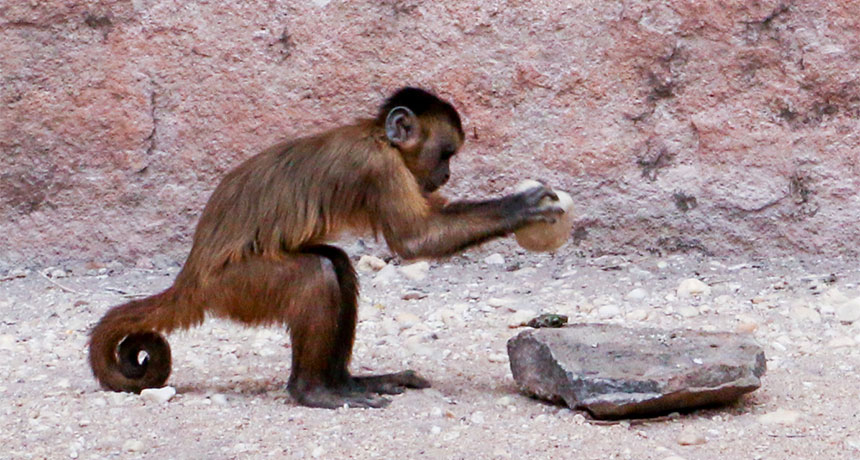
Some researchers have been claiming that they found stone tools made by humans that were in use 50,000 years ago at the Pedra Furada site in Brazil. But new research shows that Capuchin monkeys widely made and used stone tools in this area at that time. The assemblage found at Pedra Furada does not show anything beyond crude stone tools that were probably made by the Capuchin monkeys. 

The monkeys have their own rock quarries, where they selec rocks to use as hammers to crack nuts against a larger, flattened anvil rock. Rocks also come in handy for eating seeds and fruits—and the monkeys even lick the dust created from driving two rocks together, possibly as a way of adding minerals to their diets.

Stone tools assist capuchins with other tasks as well, such as digging. And the females throw rocks at potential mates as a way of demonstrating sexual interest.

All of these processes can lead to the stones breaking into smaller flaked pieces—which, the new study found, are indistinguishable from some ancient stone tools carved by early humans.
The research is published in Sage Journals’ The Holocene 

Artnet.com haș the report here:
https://news.artnet.com/art-world/ancient-tools-monkeys-2237820

Mike Ruggeri’s Pre-Clovis and Clovis News on Tumblr
http://mikeruggerispreclovisnews.tumblr.com

Ancient Maya Market System Studied

January 10, 2023

Research into the K’iche led region of Guatemala shows that trade in obsidian was manage by local people through independent trade networks. And it was based on availability and craftsmanship. So it appears this is a system based on a free market. Research was done on a geochemical and technological analysis on obsidian artifacts excavated from 50 sites around the K’iche’ capital. Where did raw material come from and what were the manufacturing techniques used.

In the capital area, centralized control and managed trade was in operation. Outside the core area in conquered areas, they obtained their own obsidian and developed obsidian markets.

The research is published in Latin American Antiquity

Phys.org has the report here;

https://phys.org/news/2023-01-mayas-market-based-economics.htm

Huge New Ancient Maya Civilizational Complex Found in Northern Guatemala

January 10, 2023

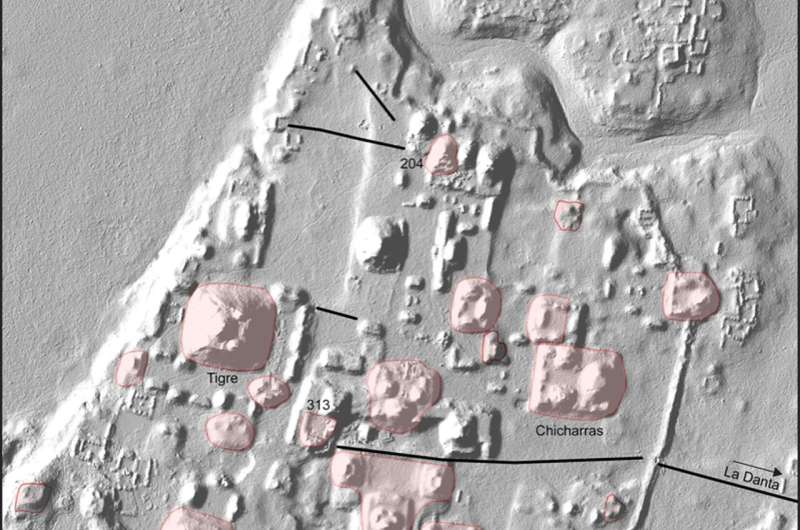
A previously unidentified Maya area now 964 settlements have been found by LIDAR flying over Guatemala’s Mirador-Calakmul Karst Basin in northern Guatemala. It is dated to 1000 BCE-150 CE covering 650 square miles with 110 miles of roads. They also built a vast causeway network. There are 775 sites in the central area and 189 sites in the surrounding area. 417 cities, towns, and villages from part of a unified civilization. Patterns, ceramics, sculptures, architecture all show this unity. Thousands of workers had to be mobilized in an area previously thought to be sparsely populated.

“The labor would include lime producers, mortar and quarry specialists, lithic technicians, architects, logistics and agricultural procurement specialists, and legal enforcement and religious officials, all operating under a political and ideological homogeneity,”

Large pyramids and platforms have been identified as well as 30 ball courts. 195 artificial reservoirs and a network of canals for transporting water was were constructed.  The study is published in the journal Ancient Mesoamerica.

The report is published here;

https://www.iflscience.com/enormous-maya-civilization-discovered-complete-with-roads-reservoirs-and-ballcourts-66804

168 New Nazca Geoglyphs Discovered in Peru

January 7, 2023

Archaeologists from Japan’s Yamagata University have discovered 168  new Nazca Lines on the Pampas de Juman in the Nazca Desert in southern Peru, the latest addition to over 800 straight lines, 300 geometric figures, and 70 animal and plant designs

The figures depict humans, camelids, birds, killer orca whales, cats, and snakes, and date to 100 BCE-300 C.E. Some measure just 10 or 20 feet long, which helps explain why they went undetected for so long. In comparison, the biggest geoglyphs measure about 1,200 feet across.

They conducted researcjwith drones, taking aerial photos, and conducting field surveys from June 2019 to February 2020, using high-resolution aerial photographs taken by drones. A.I. technology provided an assist in spotting and deciphering the age-old markings. The Nazca Lines can now be found across a 170-square-mile area.

only 5% of all existing Nazca lines have so far been found. These geoglyphs were created by removing black stones from the surface of the earth to expose a white sandy surface below.   it is unclear how the black stone was removed.

Some geoglyphs are in danger of being destroyed due to the recent expansion of mining-related workshops in the archaeological park.

Artnet haș the report here with many photos;

https://news.artnet.com/art-world/new-nazca-lines-discovery-2231132

New Research into Chincha Culture Funeral Rituals in Ancient Peru

January 6, 2023

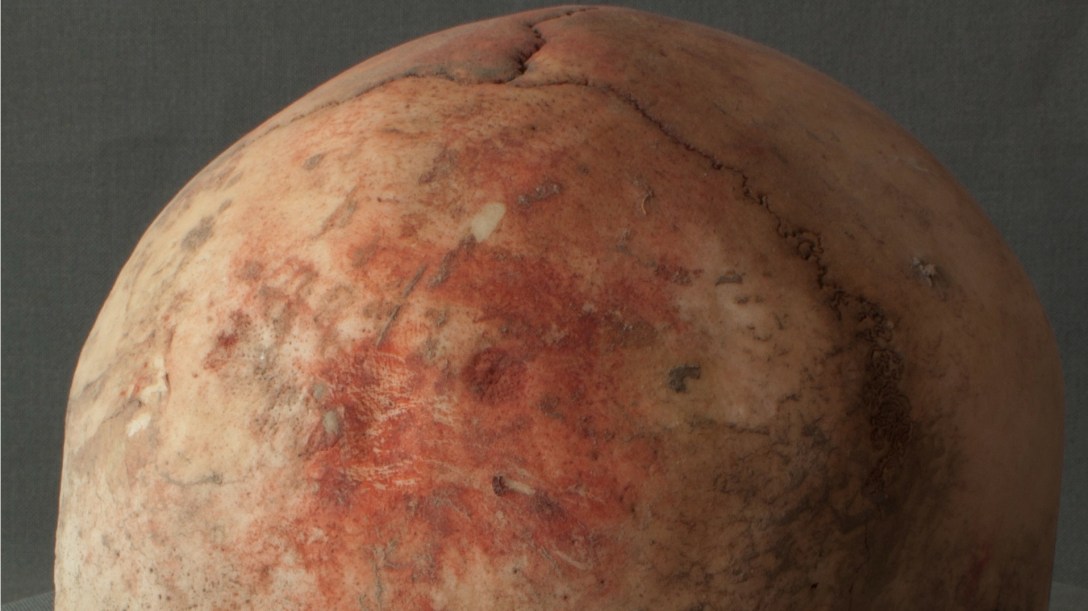
Researchers analyzed hundreds of human remains from the Chincha culture in Peru going back as far at 1000 CE in large mortuary structures to study the use of fingerprinting red pigment on skulls in funerary rituals. They found different kinds of red paint were used and only certain people were painted. Using X-ray powder diffraction, X-ray fluorescence spectrometry, and laser ablation ICP-MS, techniques, they found that 24 of the samples came from iron based ochres like hematite, 13 came from mercury based cinnabar, and one was a combination. Cinnabar came from hundreds of miles away and the hematite came from local sources.

Most of those whose skulls were painted were adult males. Bones of women and children who had healed traumatic injuries and those whose skulls were modified as babies were also painted. They used textiles, leaves and their hands to apply the pigment. It appears that the painters also entered the mortuaries to paint those who had been desecrated during the European conquest

The research is published in the Journal of Anthropological Archaeology.

Live Science has the report and photos here:

https://www.livescience.com/ancient-skulls-red-fingerpaint-peru