January 27, 2016

A New INAH Study on Human Sacrifice at Tenochtitlan

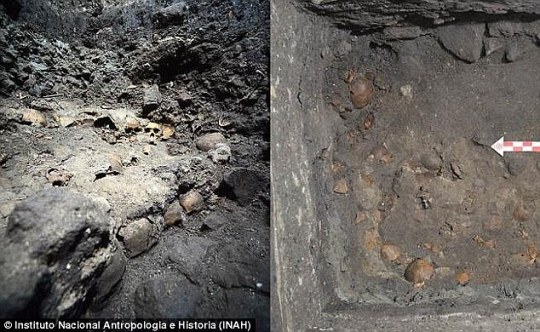
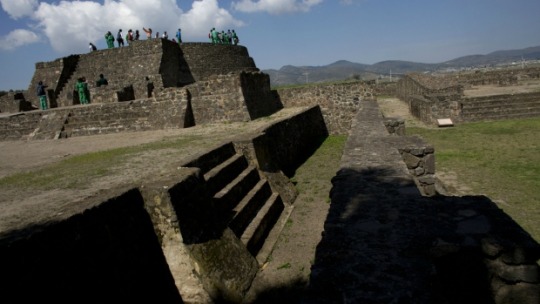
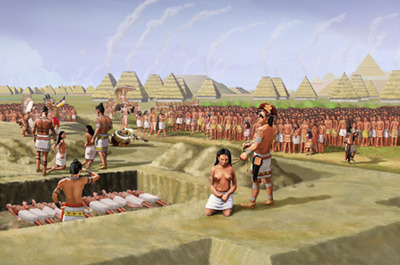
A new study by INAH of who was sacrificed at Tenochtitlan shows that many of the sacrificed were Mexica from the area and not all war captives from further afield. The skulls and teeth of six individuals who were sacrificed at the Great Temple of Tenochtitlan were studied. They were individuals who lived under the reign of Moctezuma II. The individuals studied were probably servants for the elite, and had lived at Tenochtitlan for at least six years. The article also mentions the recent finds of Aztec skull racks at the Great Temple which proves the assertions made in primary sources about the existence of these skull racks. A surprising find among these skull racks is one that has the skulls of the sacrificed mortared together into a circle, with all of the heads facing inward into a space. This find was a total surprise.

The Daily Meal has their usual great illustrated report on this discovery;
http://www.dailymail.co.uk/sciencetech/article-3417150/Did-Aztec-rulers-sacrifice-STAFF-Bones-reveals-victims-served-elite-killed-Great-Temple-Tenochtitl-n.html

Mike Ruggeri’s Toltecs and Aztecs
http://mikeruggeristoltecsandaztecs.tumblr.com

Mike Ruggeri’s Aztec and Toltec World Magazine
http://bit.ly/1ygAdbd

January 26, 2016

Unusual Lambayeque Culture Female Sacrifices Uncovered

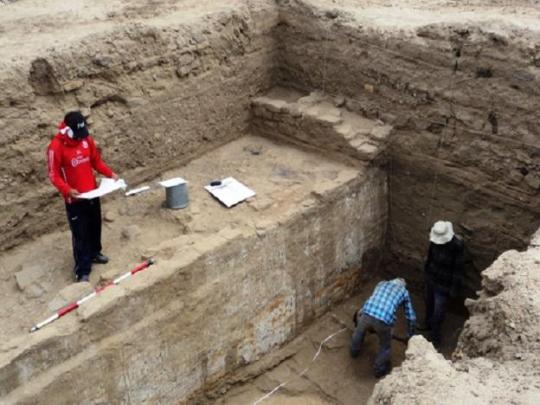
Archaeologists have found the bodies of six women ritually killed at 800 CE in the Pucala District of Peru in a secret compound of the Huaca Santa Rosa temple. The women were buried with a llama and ceramics. They were placed facing the Andes. They would have been killed in ceremonies that involved ritual costumes and drinking the victim’s blood. They were part of the Lambayeque (Sican) Culture (750-1375 CE). The women appear go have been taken as slaves or captured from other Pre-Inca Cultures.

The Daily Mail has their usual excellent photo collection of the site and a video as well;
http://dailym.ai/1nm168R

Mike Ruggeri’s Ancient Andean World
http://bit.ly/VD1spm

January 23, 2016

Ancient Weaver Remains Found in Lima

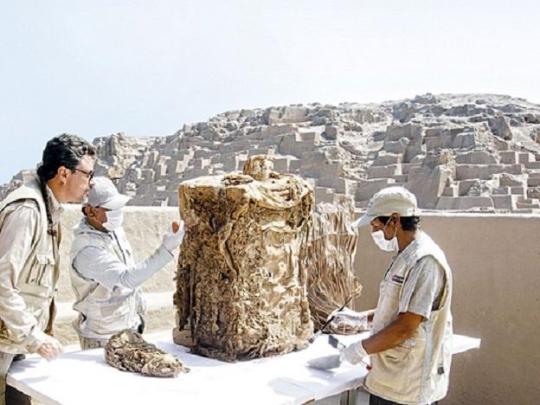
Archaeologists have uncovered the remains of a presumed weaver in the Huaca El Paraiso in Lima. The remains and weaving materials the remains were found with date to 1500 BCE. Textile instruments and products not from the coast indicate wider trading. Clay figurines similar to those found at Caral were also found.

Peru This Week has the report;
http://bit.ly/1PctoNV

Mike Ruggeri’s Ancient Andean World
http://bit.ly/VD1spm

January 15, 2016

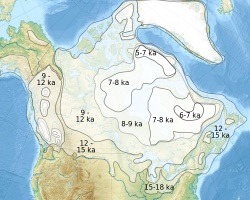
Genetic Proof for First Americans Disproves any Trans-Atlantic Migrations.

Professors Jennifer Raff and Deborah Bolnick has written report for the journal PaleoAmerica on the First Americans. She points out that all of the genetic data from mitochondrial and genomic material gathered thus far on who they were points to migrations from Siberia, and does not show evidence of any Trans-Atlantic migrations. The Solutrean hypothesis about early migrations from Europe are not supported by any solid genetic data. The argument made about the X2a haplogroup found in Kennewick Man being of European origin  is put to rest by the recent more complete study showing Kennewick Man had no proof of any European ancestry through his entire genome.

(My note; The haplogroup referred to is found in the Altaic region of Siberia as well as Europe. The rest of the genomes in any study like this will tell the origins of the First Americans. And all of that evidence shows an Asiatic origin, coming right down to the genetic studies of modern Native Americans).

PhysOrg has the report here;
http://phys.org/news/2016-01-genetic-ancient-trans-atlantic-migration-professor.html

Mike Ruggeri’s Pre-Clovis and Clovis News on Tumblr
http://mikeruggerispreclovisnews.tumblr.com

Mike Ruggeri’s Pre-Clovis and Clovis World Magazine
http://bit.ly/1uAWdvk

January 13, 2016

A New important Maya related site excavated in Honduras

A Maya site in Honduras is under excavation in the jungle of La Mosquitia by a joint American/Honduran team..  A large number of artifacts have been uncovered. 64 stone artifacts have been uncovered so far at the base of a pyramid. They are mostly stone jars and metates decorated with animal heads and geometric patterns. The culture that resided here is an unknown one. Honduran President Hernanez was allowed to remove a “were-jaguar” head that was part of a metate with legs and a stubby tail. As a result of this artifact, the area of the site is now called the “Valley of the Jaguar.” The area is in a pristine tropical wilderness far from any human habitation. Earlier reports criticized this find as a previously discovered site, but the Honduras archaeological experts are stating this is a pristine site. There is a larger site nearby to be excavated by the same team.

National Geographic has the report here;
http://news.nationalgeographic.com/2016/01/160113-honudran-lost-city-archaeology/

Mike Ruggeri’s Ancient Maya News on Tumblr
http://mikeruggerisacientmayanew.tumblr.com

Mike Ruggeri’s Ancient Maya News Magazine
http://bit.ly/1CeeXyu


January 8, 2016

A Pax Hohokam Culture?

Archaeologist Steven Shackley at the UC Berkeley has done an analysis of spear and arrow points in the Hohokam region, and chemically analyzed thousands of obsidian pieces to find their origins. He has concluded that the style of the projectile points, ceramics, burial practices, rock art, tools and origin stories are Hohokam as far north as Colorado, Flagstaff, into New Mexico and California and down into Baja. The material connection to the Hohokam throughout this entire area is strong over 50,000 square miles. From 700-1300 CE, there is little evidence of large scale violence in this area. The Hohokam were a diverse multiethnic, multilingual society. Shackley’s analysis will be a point of controversy and debate as archaeologists continue to expand our knowledge of the entire ancient Southwest.

The Payson Roundup has the report here;
http://www.paysonroundup.com/news/2015/dec/30/how-far-did-hohokam-reach/

Mike Ruggeri’s
The Ancient Southwest
http://bit.ly/X1kCou

January 5, 2016

Inca Khipus Translation Breakthrough

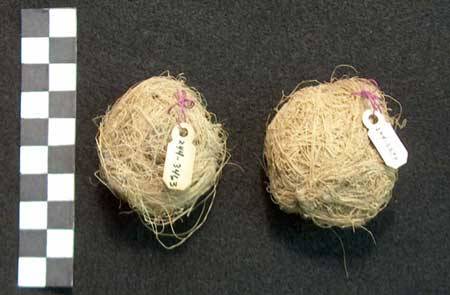
Researchers have found a storage house for agricultural products 100 miles south of Lima at the Inca site of Incahuasi. They kept records on peanuts, chilis, beans, corn etc. there. Khipus were found under the produce, preserved in the dry desert climate. The Khipus are made of cotton or wool strings with knots, and they are dyed different colors. With this new discovery, which is the first time Khipus have been found with produce like this, it may allow the researchers to identify colors and knots related to each product, thus begin to translate khipus. The site was a place where llama caravans with farm produce would have been going through. The food was probably for Inca armies invading southward. More could be found at the site, but money for further research has run out there.

The NY Times has the report here;
http://mobile.nytimes.com/2016/01/03/world/americas/untangling-an-accounting-tool-and-an-ancient-incan-mystery.html

Mike Ruggeri’s Ancient Andean World
http://bit.ly/VD1spm

December 21, 2015

More Finds at the Las Capas Site

Desert Archaeology researchers have been working at the site of Las Capas in the Tucson Basin for several years. They have found an extensive system of irrigated fields dating to 1200-800 BCE. Some maize at the site has been dated at 2100 BCE. 53 pit houses thousands of storage pits and 113,000 artifacts, including human remains have been uncovered so far. The fields would have sustained a community of 125 people. The inhabitants hunted with atlatls. Remains of deer and sheep have been found, but most of the animal remains are rabbits. They ate rabbit stew, amaranth and mesa cakes made from maize. There were human remains which showed violence; skull fractures and defensive wounds. Archaeology Southwest has published a book on the findings.

The Arizona Daily Star has the report here;
http://tucson.com/news/blogs/scientific-bent/the-early-gastronomes-of-tucson/article_a590ea11-2768-53d2-ad77-df54a5ce6516.html

Mike Ruggeri’s
The Ancient Southwest
http://bit.ly/X1kCou

Mike Ruggeri’s Ancient Southwest Magazine
http://bit.ly/1AU3vwE

December 19, 2015

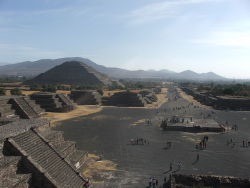
New Research on Animal Remains at Teotihuacan

Researchers have found the remains of 194 animals sacrificed at Teotihuacan in the Pyramid of the Sun and the Temple of Quetzalcoatl. The remains were of wolves, eagles, jaguars and pumas. Stress and infection traces have been found that are indicative of animals held in captivity. Isotope analysis also shows the animals were fed maize. The pumas in captivity may have eaten humans as part of ritual sacrifice.
More information: Nawa Sugiyama et al. Stable Isotopes and Zooarchaeology at Teotihuacan, Mexico Reveal Earliest Evidence of Wild Carnivore Management in Mesoamerica, PLOS ONE (2015). DOI: 10.1371/journal.pone.0135635

PhysOrg has ther report here on the PLOS ONE research
http://phys.org/news/2015-12-early-captive-carnivore-ancient-mexican.html

Mike Ruggeri’s Teotihuacan
http://mikeruggeristeotihuacan.tumblr.com

Mike Ruggeri’s Teotihuacan; City of the Gods Magazine
http://bit.ly/1z57bpL

December 1, 2015

INAH Finds Two Sealed Chambers at the Templo Mayor—Could be Aztec Ruler Tombs

INAH has found a tunnel like passageway that may lead to two sealed chambers at the Templo Mayor. The tunnel is sealed by a 3 ton rock. They had earlier found bones of eagles and two infant skulls in an offering box. It appears they were decapitated. Sacrifice knives were also found as well as other body parts at this place. INAH dug into the area and found the tunnel entrances. They will begin excavating the tunnels in 2016 to see if Aztec rulers may be buried there. If this is found, this would be the first discovery of Aztec rulers tombs.

US News has the report here;
http://www.usnews.com/news/science/news/articles/2015/12/01/mexico-experts-passageway-may-lead-to-aztec-rulers-tomb

INAH has a slide show of the finds here. (click on the tiny green camera icon under the cover photo;
http://www.inah.gob.mx/es/boletines/4948-revelan-hallazgos-durante-la-primera-mesa-redonda-de-tenochtitlan

Mike Ruggeri’s Ancient Americas News on Tumblr
http://michaelruggeriancientamericas.tumblr.com

Mike Ruggeri’s Toltecs and Aztecs
http://mikeruggeristoltecsandaztecs.tumblr.com

Mike Ruggeri’s Aztec and Toltec World Magazine
http://flip.it/T5rRJ

November 27, 2015

Ancient Ichma Culture tombs found in Lima, Peru

Four ancient bodies have been excavated in a Lima, Peru neighborhood. They were wrapped in textiles and facing the sea. They were buried in separate tombs. They belonged to the Ichma culture which dates to
1000 -1440 CE. Some of the skeletons still have hair. They were buried with ceramic pots and weaving tools. There are 350 ancient ceremonial complexes in Lima. Sixteen were built by the Ichma culture. The four bodies were found at the site of Huaca Pucllana. Archaeologists are expecting to find more tombs at the site.

The Daily Mail has the story here with their usual excellent photos and videos.
http://www.dailymail.co.uk/sciencetech/article-3336096/Mystery-SITTING-mummies-1-000-year-old-bodies-pre-Incan-civilisation-buried-looking-sea.html

Mike Ruggeri’s Ancient Andean News on Tumblr
http://mikeruggerisancientandeannews.tumblr.com

Mike Ruggeri’s Ancient Andean News Magazine
http://bit.ly/1KJvVt1

November 22, 2015

New Important Discoveries at  Zultépec-Tecoaque in Tlaxcala

A new discovery has been made at the Zultépec-Tecoaque archaeological site in Tlaxcala. INAH has found the skeleton of a high ranking Acolhua leader in a cistern, a full size throne made of volcanic rock, and a carved stone with the pictograph of Ometochtli or “Two Rabbit.” The site dates to 1200-1521 CE. The glyph of Two Rabbit is associated with pulque. Pulque was produced in this area. The buried individual was 25 years old. They have also found a cistern with the bones of three different infants that had been cooked or boiled and possibly eaten.

Mexico News Daily has the report here;
http://mexiconewsdaily.com/news/evidence-of-pulque-god-found-in-tlaxcala/

INAH has more details in their report with a slide show of the finds. (click on the little green camera icon under the photo).
http://www.inah.gob.mx/es/boletines/4933-hallan-entierro-de-personaje-vinculado-con-ometochtli-dios-del-pulque-en-tlaxcala

Earlier report I posted on surprising finds at this site;

Decapitated Spaniards from 1520 Convoy Uncovered at the site of Zultepec-Tecoaque

In 1520 CE, the Alcohua town of Zultepec-Tecoaque captured a supply convoy of 15 Spaniards and 45 food soldiers of Cuban and African descent, women and 350 Indian allies a year after the conquest of Tenochtitlan. The townspeople carved clay figurines of the captives, and sumbolically decapitated the figurines. The captives were then sacrificed and eaten. The captives were held in cells for six months and then all were slowly canibalized, to ask the gods for protection from them. The pigs the Spaniards brought were left uneaten. These would have been strange creatures to the invaded. The captives were torn apart and the meat removed from their bones. One woman was found dismembered with the skull of a one year old placed in her pelvis. Spanish valuables like majolica china, jewelry, spurs, stirrups were tossed into wells. A horse’s rib bone was carved into a musical instrument. The heads of the captives were placed on a skull rack. Cortes dispatched a punitive expedition. The townspeople then hid all of the remains of the Spaniards, which has allowed archaeologists to find the remains.

CTV News has the report here from INAH;
http://www.ctvnews.ca/sci-tech/excavation-of-mexican-site-reveals-decapitation-of-conquistadors-1.2602422

Mike Ruggeri’s Mesoamerica News on Tumblr
mikeruggerismesoamericanews.tumblr.com

Mike Ruggeri’s Toltecs and Aztecs
http://mikeruggeristoltecsandaztecs.tumblr.com

November 19, 2015

Earlier Pre-Clovis Dates Found at Monte Verde

Tom Dillehay, the archaeologist who excavated the first proven Pre-Clovis site in the Americas, Monte Verde, Chile has just published results of his latest excavations at the site. He has uncovered artifacts with burned features that are dated to 16,500 BCE. He found burned faunal remains, worked stones, and human knapped flakes that date to 16,500-12-500 BCE. The site is a seasonal site where humans periodically camped. The idea that humans spread rapidly from established sites across the Americas is now in question. Coastal travel for the First Americans was probably easy, but moving inland may have had many difficulties. The earliest human skulls found in the Americas are surprisingly variable, and the earliest populations may have been largely wiped out by later arrivers. The traces of the earliest people may have been found in recent gentic studies in modern South American populations.

The latest research by Tom Dillehay is on PLoS One 10 (see reference below):
http://journals.plos.org/plosone/article?id=10.1371%2Fjournal.pone.0141923

John Hawkes has the report here;
http://johnhawks.net/weblog/reviews/archaeology/america/dillehay-monte-verde-2015.html

Mike Ruggeri’s Pre-Clovis and Clovis World
http://bit.ly/11wqze5

Mike Ruggeri’s Pre-Clovis and Clovis World Magazine
http://bit.ly/1uAWdvk

Mike Ruggeri’s Pre-Clovis and Clovis News on Tumblr
http://mikeruggerispreclovisnews.tumblr.com

November 13, 2015

Ancient Inca Child Mummy Has DNA Sequenced

Forensic geneticists have sequenced the DNA of a frozen seven year old Inca boy mummy. He was found to have originated far to the north in the Peruvian Andes and belonged to a genetic sub-group of  unidentified Paleo-Indians. He was sacrificed 500 years ago in the Inca capacocha ritual, where perfectly unblemished children were offered to the gods by drugging them and letting them freeze in the high mountains. He was found in 1985. He was wrapped in textiles and buried with six statuettes. It is believed his group dates to 12,300 BCE. The genetic lineage of the child is almost extinct today, but his line would have been more frequent in Inca times.

The Daily Mail has the story here with their usual excellent photos and a short video from NatGeo showing another Inca child mummy, a girl, being studied. The preservation is remarkable.
http://dailym.ai/1N0NFH5

Science Magazine adds that “they will map the complete nuclear genome of the Aconcagua boy and to sequence the DNA of all the microbes preserved in the mummy’s gut, including his microbiome and any infectious germs he might have been carrying. That could help scientists understand how microorganisms—both the ones that hurt us and the ones that help us—have evolved over time. Wilson hopes similar studies can be done on other capacocha mummies.”
http://news.sciencemag.org/archaeology/2015/11/inca-child-mummy-reveals-lost-genetic-history-south-america

Mike Ruggeri’s Ancient Andean News on Tumblr
http://mikeruggerisancientandeannews.tumblr.com

Mike Ruggeri’s Ancient Andean News Magazine
http://bit.ly/1KJvVt1

November 3, 2015

Further Research at Ceren in El Salvador

The site of Ceren in El Salvador is the best preserved site in Latin America due to its being covered by volcanic ash in 660 CE. The preservation is so great, finger swipes on ceramic bowls and footprints in gardens, bean-filled pots, woven blankets have been found there. The villagers there had freedom in their architecture, crops, rituals, economics. 200 people lived there. 12 buildings have been excavated, including storehouses and workshops. No bodies have been found, perhaps because the villagers may have left at a precursor earthquake, before the volcanic eruption. The villagers traded crops and crafts for jade axes for tool use, polychrome pots, obsidian knives at a public market. There appears to have been a crop harvest festival ongoing when disaster struck. They probably fled on a raised sacbe. White Sacbes were only known in the Yucatan until the discovery of the one at Ceren. Researchers are studying the sacbe for the signs of the exodus south. It appears the sacbe was constructed in family work units supervised by elders. Some households maintained a wood supply for the sweat bath for the community sauna building. Lead archaeologist Payson Sheets found manioc fields at Ceren. The only place intensive manioc cultivation was ever found. It was used for tortillas, tamales, and alcoholic beverages.
The work has been funded by the University of Colorado at Boulder, National Geographic Society, the Smithsonian Institution, the Getty Conservation Institute and a number of universities.

The University of Colorado at Boulder has the news report here.
http://www.colorado.edu/news/releases/2015/11/03/cu-boulder-study-shows-ancient-salvadoran-village-buried-ash-frozen-time

Mike Ruggeri’s Mesoamerica News on Tumblr
http://mikeruggerismesoamericanews.tumblr.com

Mike Ruggeri’s Ancient Maya News on Tumblr
http://mikeruggerisacientmayanew.tumblr.com

November 2, 2015

9000 Ancient Artifacts Uncovered in the Mojave Desert

Archaeologists have found 9,000 artifacts representing 11,500 years of history. 8,830 stone tools, flakes, ceramics, bone and a Clovis blade made from jasper have been uncovered in the Mojave desert. They also perused older research reports from this area, which is on a Marine base. 19 Western Stemmed Tradition points and 14 Pinto points had been found in the area, dating to 4000-6,500 BCE. Most of the artifacts uncovered by this team date to 5000-7000 BCE. The team has requested that the two most productive sites be placed on the Department of the Interior’s National Register of Historic Places.
Byerly and his colleagues report their findings in the journal Paleoamerica.
Byerly, R., & Roberson, J. (2015). Late Pleistocene to Middle Holocene Archaeology in the Mojave Desert: Recent Discoveries in Twentynine Palms, California PaleoAmerica, 1 (2), 197-201 DOI: 10.1179/2055556315Z.00000000020

Western Digs has the report here;
http://westerndigs.org/nearly-9000-artifacts-uncovered-in-california-desert-spanning-11500-years-of-history/

Mike Ruggeri’s Pre-Clovis and Clovis World Magazine
http://bit.ly/1uAWdvk

Mike Ruggeri’s Pre-Clovis and Clovis News on Tumblr
http://mikeruggerispreclovisnews.tumblr.com

November 1, 2015

Human and Feline Trophy Heads Uncovered in Peru

Twelve human trophy heads and one feline trophy head have been found in a cemetery in Peru. The area is dated to 600-1100 CE. The heads were skinned and drilled with holes for cords. The feline head had its eyes stuffed with red textiles. Feline trophy heads are seen on pottery, but this now proves that the representations are real. Both Nazca and Wari style trophy heads were found, based on skull perforation styles. The heads were probably attached to headdresses or worn as masks in ritual performances. Isotopic analysis is now taking place.
For more information on the project; www.experiment.com/trophyskulls.

Peru This Week has the report here with a video;
http://www.peruthisweek.com/news-human-and-feline-trophy-heads-excavated-near-toro-muerto-arequipa-107961

Mike Ruggeri’s Ancient Andean News Magazine
http://bit.ly/1KJvVt1

Mike Ruggeri’s Ancient Andean News on Tumblr
http://mikeruggerisancientandeannews.tumblr.com

October 31, 2015

11,500 Year Old Infant Burials in Alaska Studied

Archaeologists have found two infants buried with a stone cutting tool and animal antlers with spear points in an 11,500 year old burial at the Upward Sun River site in Alaska. They belong to two genetic groups. Their genetic makeup lends itself to the idea that humans lived in a dry area that existed between Siberia and Alaska 30,000 years ago called Beringia. Humans may have spent as many as 10,000 years in Beringia before moving rapidly into America 15,000 years ago. Since the two lineages represented by the two infants lived so far north so long ago, their genes support the “Beringian Standstill Model.” The genetic variation of the two may be showing that the 10,000 year hiatus in Beringia gave rise to genetic diversity before they came into the Americas. The lineages of the infants are not found in Siberia or Asia, so they must have drifted from Asiatic groups during those 10,000 years in Beringia.
Genetic material has been found at eight sites in North America older than 8,000 years. In these eight sites, all five major lineages of Native Americans are present, indicating the the Beringian population gave rise to all of the lineages. One of the two infants is the ancestor of tribes in Arizona, California, Bolivia, Tainos and in Illinois. The other infant is the ancestor of Washington, Arizona, California and Peruvian tribes.

(my note; The idea is that populations in Beringia could not move into the Americas during those 10,000 years of the standstill due to a huge untrekkable area of ice that stood between them and the Americas. This still does not preclude the idea that other Asiatic peoples escaped this standstill by taking a canoe route down the Pacific Coast in earlier times. The Pre-Clovis finds at Monte Verde, Chile and Paisley Cave in Oregon would be examples of these earlier arrivers).

My Pre-Clovis and Clovis web site has a section on Beringian studies, published before this research, as well as on Paisley Cave and Monte Verde, for further elucidation.

Mike Ruggeri’s Pre-Clovis and Clovis World
http://bit.ly/11wqze5

The Daily Mail has the report on the two infants with their usual great illustrations;
http://dailym.ai/1PbgKON

October 29, 2015

Inca Mountain Sanctuary Used for Child Sacrifice Uncovered

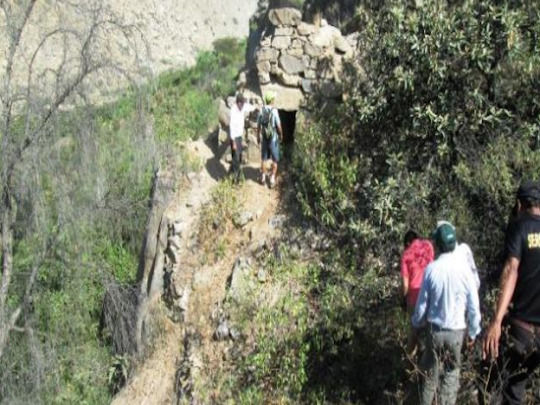
An Inca mountain sanctuary used to sacrifice children to the gods has been discovered in the Vilcamba mountains near Cusco. They also found a cave system used as a necropolis to bury the sacrificed. The site dates to 1471-1493 CE. At this time in Inca history, children were sacrificed in times of drought and natural disaster, in hopes the gods would bring relief. Children were also sacrificed upon the death of a king. The ceremony was called Capacocha. Unblemished children were selected, married, returned to their local communities, before being sacrificed to the Llullaillaco Volcano. The team has found 50 structures. The site was found using satellite imagery and local stories. Rectangular buildings called kanchas, surrounded by other buildings have been found there. The site may be part of the legendary Kingdom of Vilcabamba, the last Inca nation.

The Daily Mail has the story with their usual excellent photos of the find. They are the best in the business for archaeology news photos;
http://dailym.ai/1RbCSHH

Mike Ruggeri’s Ancient Andean News on Tumblr
http://mikeruggerisancientandeannews.tumblr.com

Mike Ruggeri’s Ancient Andean News Magazine
http://bit.ly/1KJvVt1

October 28, 2015

Mississippian Influence in the Fort Ancient Culture Found

Researchers have investigated the dental isotopes of individuals from six Fort Ancient, Ohio sites, and one site in Indiana. They studied 152 individuals. They found that 18% of the population studied are potentially non-local. The Turpin Site, the most Mississippian of the sites studied, had the most non-local individuals. The study also shows that maize eating in the Fort Ancient culture was an abrupt new dietary adaptation. This is linked to the arrival of Mississippians, possibly from Cahokia. The new arrivers may have come as missionaries, captives or marriage partners.
The research is published in the Journal of Archaeological Science

The great Bradley T. Lepper Publishes this synopsis in the Columbus Dispatch;
http://www.dispatch.com/content/stories/science/2015/10/25/1-did-missionaries-influence-earliest-ohioans.html

Mike Ruggeri’s Adena and Hopewell World
http://bit.ly/Mj7I1L

Mike Ruggeri’s Adena, Hopewell, and Fort Ancient Cultures Magazine
http://bit.ly/1966ruf

October 24, 2015

Mummies Uncovered at the Chimu site of Chan Chan

Peruvian archaeologists have found 32 mummies at and near the site of Chan Chan. Jewelry, textiles and other artifacts were buried with the mummies. The Chimu culture built the city of Chan Chan between 900-1500 CE. All the mummies were adults, and the majority were women. The newly found artifacts date to 1400 CE. The females were probably sacrificed to accompany authorities buried in a main chamber. The artifacts will be rigorously tested to find out more. At the same time, archaeologists found a female mummy covered in textiles in a basket woven of dried stalks. Cotton and corn were placed next to her. She may be from the Lima Culture dating to 900-1470 CE. Excavations will now begin in this area.

Ancient Origins has the story with photos here;
http://www.ancient-origins.net/news-history-archaeology/thirty-two-pre-hispanic-mummies-uncovered-peru-004245

Mike Ruggeri’s Ancient Andean News on Tumblr
http://mikeruggerisancientandeannews.tumblr.com

Mike Ruggeri’s Sican/Chimu Era Peru
http://mikeruggerissicanchimu.tumblr.com

October 20, 2015

Zacpeten Arrowheads Show Human Bloodletting

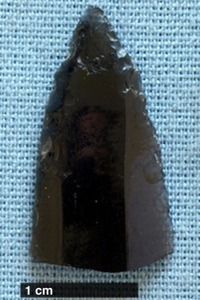
An ancient obsidian arrowhead found at the Maya site of Zacpeten in Guatemala with human blood on it is indicative of a Maya bloodletting ceremony. The Maya were feeding the gods with the life force of human blood. Researchers studied 108 arrowheads from five sites in Guatemala dating from 1400-1700 CE. They found blood on 25 of the arrowheads. Two of the arrowheads had human blood. The rest had animal blood. The Mesoamericans also used jadeite spikes, obsidian blades, stingray spines and shark’s teeth in bloodletting ceremonies.
The research is published in the Journal of Archaeological Science.

Ancient Origins has the story here;
http://www.ancient-origins.net/news-history-archaeology/human-blood-found-ancient-maya-arrowheads-bloodletting-rituals-feed-life-020576

Mike Ruggeri’s Ancient Maya News on Tumblr
http://mikeruggerisacientmayanew.tumblr.com

Mike Ruggeri’s Ancient Maya News Magazine
http://bit.ly/1CeeXyu

October 16, 2015

New Vast Area Finds at the Pig Point Site in Maryland

Archaeologists at the Pig Point site in Maryland, which dates back to 7,205 BCE, are now finding evidence of a vast settlement surrounding the ceremonial core of the site. 450 test pits over a quarter mile area almost all had artifacts. They have already found projectile points and pottery going back to 6,000 BCE. In 2012, they found a burial grounds with 1,000 individuals spanning thousands of years. A new projectile point find dates back to 8,000 BCE. 14 new sites have been uncovered in the last few seasons. As the sea rises along the coast, much of this archaeology will be under water.

The Capital Gazette has the news here with a video;
http://www.capitalgazette.com/news/ph-ac-cn-pig-point-plus-1011-20151011-story.html

Mike Ruggeri’s The Ancient America’s Breaking News
http://bit.ly/UbLO7x

October 12, 2015

Unusual Burials found at a Site Dating Back to 7,000 CE in California

A  site in California, Marsh Creek Village, that stretches back 7,000 years has been found with unusual burials. Six individuals were decaptitated and six others with an extra skull by their sides. In two graves, the skulls have been crafted into polished bowls. There are no signs of violence. The site was uncovered in 2002. They found 500 burials, and artifacts dating back 7,000 years. These were people who lived as sedentary hunter-gatherers, eating acorns, seeds, fish and small game. The ones found with no skulls and those with extra skulls buried with them are not unique. Researchers have studied the chemistry of the teeth and bones of 200 individuals at the site. The burials with the skull ritual had the same strontium signature in their teeth as the others at Marsh Creek. And there was no sign of violence or injury. The skull ritual may have been related to kinship and ancestor worship. Often, in these kinds of cases, bones are made into flutes and whistles. The teeth in two of these special burials show a sharp drop in nitrogen in their diet at 12-21 months of age. Both had been weaned from their mothers suddenly and at a young age. Perhaps the mothers died early, and the two were adopted. Perhaps the skulls were re-united with the mother in death.
These findings are posted in the journal American Antiquity.

Western Digs has the report here with photos;
http://westerndigs.org/severed-heads-skull-bowls-found-in-california-graves-were-tributes-not-war-trophies-study-finds/

Mike Ruggeri’s The Ancient America’s Breaking News
http://bit.ly/UbLO7x

image

October 9, 2015

Decapitated Spaniards from 1520 Convoy Uncovered at the site of Zultepec-Tecoaque

In 1520 CE, the Alcohua town of Zultepec-Tecoaque captured a supply convoy of 15 Spaniards and 45 foot soldiers of Cuban and African descent, women and 350 Indian allies a year after the conquest of Tenochtitlan. The townspeople carved clay figurines of the captives, and sumbolically decapitated the figurines. The captives were then sacrificed and eaten. The captives were held in cells for six months and then all were slowly cannibalized, to ask the gods for protection from them. The pigs the Spaniards brought were left uneaten. These would have been strange creatures to the invaded. The captives were torn apart and the meat removed from their bones. One woman was found dismembered with the skull of a one year old placed in her pelvis. Spanish valuables like majolica china, jewelry, spurs, stirrups were tossed into wells. A horse’s rib bone was carved into a musical instrument. The heads of the captives were placed on a skull rack. Cortes dispatched a punitive expedition. The townspeople then hid all of the remains of the Spaniards, which has allowed archaeologists to find the remains.

CTV News has the report here from INAH;
http://www.ctvnews.ca/sci-tech/excavation-of-mexican-site-reveals-decapitation-of-conquistadors-1.2602422


Mike Ruggeri’s Mesoamerica News on Tumblr
http://mikeruggerismesoamericanews.tumblr.com

Mike Ruggeri’s Toltecs and Aztecs
http://mikeruggeristoltecsandaztecs.tumblr.com

image

October 9, 2015

Decapitated Spaniards from 1520 Convoy Uncovered at the site of Zultepec-Tecoaque

In 1520 CE, the Alcohua town of Zultepec-Tecoaque captured a supply convoy of 15 Spaniards and 45 foot soldiers of Cuban and African descent, women and 350 Indian allies a year after the conquest of Tenochtitlan. The townspeople carved clay figurines of the captives, and sumbolically decapitated the figurines. The captives were then sacrificed and eaten. The captives were held in cells for six months and then all were slowly cannibalized, to ask the gods for protection from them. The pigs the Spaniards brought were left uneaten. These would have been strange creatures to the invaded. The captives were torn apart and the meat removed from their bones. One woman was found dismembered with the skull of a one year old placed in her pelvis. Spanish valuables like majolica china, jewelry, spurs, stirrups were tossed into wells. A horse’s rib bone was carved into a musical instrument. The heads of the captives were placed on a skull rack. Cortes dispatched a punitive expedition. The townspeople then hid all of the remains of the Spaniards, which has allowed archaeologists to find the remains.

CTV News has the report here from INAH;
http://www.ctvnews.ca/sci-tech/excavation-of-mexican-site-reveals-decapitation-of-conquistadors-1.2602422


Mike Ruggeri’s Mesoamerica News on Tumblr
http://mikeruggerismesoamericanews.tumblr.com

Mike Ruggeri’s Toltecs and Aztecs
http://mikeruggeristoltecsandaztecs.tumblr.com

October 6, 2015

Possible Pre-Clovis Find With Wolly Mammoth in Wisconsin

A wooly mammoth dated to between 11,700-15,000 years ago has  been excavated in Michigan. Large parts of the remains of the mammoth were excavated aling with possible stone tools for cutting and anchoring. The vertebra were arrayed in correct anatomical sequence and not scattered. A pond may have been used for storage. Cut marks on the bones will be sought and dated. The dates may be within the Clovis range, but there is a chance that the dates will be Pre-Clovis.

Archaeology.org has the report here, with a photo;
http://www.archaeology.org/news/3736-151005-michigan-mammoth-bones

And Mashable has a number of photos here;
http://mashable.com/2015/10/03/michigan-mammoth-fossils/#TKAcVLp6ePq5

Mike Ruggeri’s Pre-Clovis and Clovis World Magazine
http://bit.ly/1uAWdvk

September 29, 2015

850 BC Massacre Site Uncovered Near San Francisco

A mass grave of seven men dated to 850 CE was uncovered in the construction of a shopping mall near San Francisco. They range in age from 18-40. They had severe head wounds, broken limbs, and obsidian weapons in their remains. Chemical analysis shows they were far from home. This is another example of the violence among hunter-gatherers in the region. This was an area of high population density during this era. The researchers set about reconstructing the life history of the men. By studying the chemistry of their teeth, they found that the men spent their lives together, and differed completely from the other burials in the Amador Valley. They lived further inland and ate freshwater fish. Their chemical signature placed them to the southeast in the San Joaquin Valley. The researchers then studied the mitochronial DNA of the men. It was found they came from at least four different families. They will study the remains further looking for tobacco or hallucinogenic use, and possible infections or diseases.
Eerkens and his colleagues report their findings in the American Journal of Physical Anthropology.

Western Digs has the report here;
http://westerndigs.org/mass-grave-found-in-california-reveals-prehistoric-violence-against-outsiders/

Mike Ruggeri’s Ancient Americas Magazine
http://bit.ly/1Fv42nv

September 24, 2015

Earliest Decapitation in the Americas Found in Brazil

Archaeologists have uncovered the earliest evidence of ritual decapitation in the Americas at a 9,000 year old site in Brazil. Decapitation of enemies is a common practice in the ancient Americas. The oldest ritual beheading in South America until this discovery was 3,000 years ago in Peru. And the oldest in North America was in Florida, 6,000-8,000 years ago. The Brazilian site is called Lapa do Santo in a tropical region of Brazil. This is the same site where the oldest evidence of rock art in South America was found, dating to 9,400 years ago. Humans occupied this site from 12,000 years ago. The ritual decapitation was discovered in 2007, and is only now being published in the peer reviewed journal PLOS ONE. The person decapitated had his hands amputated and laid palm side down on the face of the skull. The left hand was pointed upward covering one side of the face, and the left hand pointed downward covering the other side of the face. Analysis of the bones indicates the person was from the group that lived there, so the decapitation may have been a ritual burial rite.

Live Science has the report here;
http://www.livescience.com/52278-oldest-human-decapitation-in-new-world.html

And they have posted a separate page of photographs from the site;
http://www.livescience.com/52275-photos-oldest-human-decapitation.html

September 19, 2015

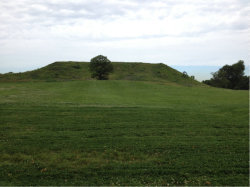
Monk’s Mound at Cahokia May Have Been Built in only 20 Years

Researchers studying the largest mound at Cahokia, Monk’s Mound, are speculating that the moound may have been built very quickly. It has been believed that the mound took 250 years to build in 14 stages. the new research took samples from the mound when repairs on the mound were being done in 2005. They looked at plant remnants and found the non-food plants were annuals that live only one to five years. The evidence suggests that construction was continuous. And the plant remains point to Monk’s Mound being built in only 20 years. The unburned remains of the plants were well preserved and not decayed as they would have been over 250 years. And they also found that parts of the mound were constructed with whole sod blocks and not basktfuls of soil.

Lopinot and Schilling report their findings, with colleagues Gayle Fritz and John Kelly of Washington University, in the Midcontinental Journal of Archaeology.

Western Digs has the story here;
http://westerndigs.org/americas-largest-earthwork-cahokias-monks-mound-may-have-been-built-in-only-20-years-study-says/

Mike Ruggeri’s Moundbuilders/Ancient Southwest News on Tumblr
http://mikeruggerisancientnorthamerica.tumblr.com

September 16, 2015

Elaborate 700 BCE Tomb Uncovered at Pacopamapa, Peru

Archaeologists have unearthed a tomb at Pacopampa, Peru dated to 700 BCE. It is a double burial of high ranking priests from the Pacopampa Culture. They were placed looking north and south. A necklace of 25 gold beads and a black ceramic bottle designed in a serpent/jaguar motif were placed in the tomb. Red, green, brown, black, and white pigments were placed in front of one skull. They exhibited cranial deformation, indicating their elite status. This may be the site of a much larger complex, and the team will continue digging and doing more research on the priests.

Ancient Origins has the story here with a set of very good photos of the finds;
http://www.ancient-origins.net/news-history-archaeology/lost-2-700-years-tomb-serpent-jaguar-priests-uncovered-peru-003852

Mike Ruggeri’s Ancient Peru (5000 BC-600 BC)
http://mikeruggerisancientperu.tumblr.com

Mike Ruggeri’s Ancient Andean News on Tumblr
http://mikeruggerisancientandeannews.tumblr.com

September 12, 2015

10,000 Year Old Tools Found at Puget Sound

Archaeologists have found 10,000 year old stone tools in Redmond, Puget Sound. They have unearthed 4000 flakes, scrapers, awls and spear points. The spear points had traces of bison, deer, bear,. The points are also not Clovis in style.

The Seattle Times has the report here with photos;
http://www.seattletimes.com/seattle-news/science/10000-year-old-stone-tools-unearthed-in-redmond/

Mike Ruggeri’s Ancient Americas Magazine
http://bit.ly/1Fv42nv

September 7, 2015

Widespread Caffeine Trade Between Ancient Southwest and Mesoamerica Found

Researchers analyzed 177 samples of pottery from ancient Colorado to Chihuahua spanning 750-1400 CE. 22% of the ceramics contained either cacao or the “black drink” that was made from yaupon holly. Yaupon holly is highly caffeinated. Both ingredients were grown in Mesoamerica and the Gulf Coast. It does not grow in the Southwest. The sites included Chaco’s Chetro Ketl, Snaketown in Arizona and Windy Knob in Colorado. This study shows prolonged and sustained contact with Mesoamerica.
Crown and Hurst report their findings in the Proceedings of the National Academy of Sciences.

Western Digs has the story here;
http://westerndigs.org/use-of-cocoa-black-drink-widespread-in-pre-contact-southwest-study-finds/

Mike Ruggeri’s Aztlan World
http://mikeruggerisaztlanworld.tumblr.com

August 26, 2015

New Research on Mass Burials at Cahokia.

Researchers have been studying mass sacrifices at the site of Cahokia which took place between 1000-1100 CE. 270 bodies were found in a mass grave at Mound 72, mostly young women. They were killed by strangulation or bloodletting. And there was a separate group of 39 men and women in a separate deposit that evidenced brutal fractures, stone points embedded in their bones, decapitation. The researchers have found that all of the victims came from Cahokia or very nearby. The 39 dead who died brutally may have been part of an isolated group at Cahokia, since they differ from those in the larger mass grave in some respects. They analyzed 203 teeth from 109 individuals. They studied 24 individuals in a mass burial mound dated to 1000 CE, 50 individuals at another burial site dated to 1050 CE, and another two-layered mass burial containing peaceful burials on top and mutilated individuals beneath. They were lined up and pushed in. The strontium levels in the teeth of the dead shows most were local to Cahokia. A few were not local in each burial site. But the brutally killed were all local to Cahokia.
These findings refute theories that the sacrificed were tributes from other areas outside of Cahokia or war captives.
The team reports their findings in the American Journal of Physical Anthropology.

Western Digs has the report here;
http://westerndigs.org/victims-of-human-sacrifice-at-cahokia-were-locals-not-captives-study-finds/

Mike Ruggeri’s Moundbuilders/Ancient Southwest News on Tumblr
http://mikeruggerisancientnorthamerica.tumblr.com

Mike Ruggeri’s Ancient Southwest/Mound Builders News Magazine
http://bit.ly/16PP9jH

August 20, 2015

Huge Aztec Skull Rack Found Near the Templo Mayor in Mexico City

INAH archaeologists have found the main skull rack where the Aztecs displayed the severed heads of their sacrificed victims after their hearts were torn out on top of the main pyramid at the Templo Mayor in Mexico City. The skulls were all looking inwards. Their heads were cemented together to look inwards. This was a surprise. 35 skulls can be seen so far. Many more will be revealed as they dig deeper. A Spanish chronicle spoke of these cemented together skulls, but none had ever been found until now. The skull rack was buried under a three story colonial house in the city center. Archaeologists have been looking for the big skull rack since 1914, and this is probably the one that was sought. The skulls were hung on layered wooden posts after holes were driven through them to fit the wooden posts through the skulls.

The Daily Mail has the report here with their usual excellent photo display;
http://www.dailymail.co.uk/sciencetech/article-3205251/Mexico-finds-main-skull-rack-Aztec-temple-complex.html

Mike Ruggeri’s Toltecs and Aztecs
http://mikeruggeristoltecsandaztecs.tumblr.com

August 19, 2015

New Rock Art Research in Utah

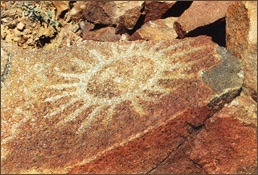
Rock art researchers investigating Fremont rock art at Utah’s Black Dragon Canyon have deciphered strange rock art images which defied explanation till now. Researchers in the past said that the images looked like an ancient animal.  The researchers used cutting edge technology; DStretch and a portable X-ray fluorescence device. They found that the paintings show five separate images, including a tall bug-eyed person, a smaller person, a sheep, a dog and a serpentlike figure.

The study was published in the August issue of the journal Antiquity.
http://www.livescience.com/51886-winged-monster-rock-art-deciphered.html

Mike Ruggeri’s Moundbuilders/Ancient Southwest News on Tumblr
http://mikeruggerisancientnorthamerica.tumblr.com

Mike Ruggeri’s Ancient Southwest/Mound Builders News Magazine
http://bit.ly/16PP9jH

August 18, 2015

New Research at the Collins Site in Illinois

Illinois Archaeologists have been excavating at the Collins Site in Illinois. The site is dated to 1000-1100 CE. During their time, the bow and arrow was introduced along with maize cultivation. The huge site of Cahokia boomed during this time, and Cahokian influence can be seen at the Collins site in pottery and buildings. There are seven mounds at the site, including a platform mound. The platform mound is called the Indian Springs Mound, and was probably a crematory site. Burnt red cedar, a ceremonial wood, and a scaffold with the remains of five bundled individuals were found there. The site was covered over after this. The site may have been temporary, used for feasting and ceremonies. The site was abandoned in 1100 CE and the inhabitants moved 25 miles to the Caitlin site.

The Canton Daily Ledger has the story here;
http://www.cantondailyledger.com/article/20150807/NEWS/150809687/-1/sports/?Start=1

More on the work at the Collins site here;
http://www.isas.illinois.edu/news/collins_site_reconstruction.shtml

Mike Ruggeri’s Moundbuilders/Ancient Southwest News on Tumblr
http://mikeruggerisancientnorthamerica.tumblr.com

Mike Ruggeri’s Ancient Southwest/Mound Builders News Magazine
http://bit.ly/16PP9jH

August 14, 2015

Kulkulkan Pyramid at Chichen Itza Built Over an Underground River

Using a new method of electrical tomography, UNAM and INAH researchers have found that the pyramid of Kulkulkan at Chichen Itza is built on top of an underground river chamber that is connected to surrounding cenotes. Limestone layers lie on top of the water. The river is to one side of the pyramid, so the pyramid is not in danger of collapsing soon. The pyramid may have been built over the river as the center of the universe, surrounded by cenotes on all four sides, which represent the four corners of the universe.

The Guardian has the story here;
http://www.theguardian.com/world/2015/aug/14/subterranean-river-discovered-beneath-mexicos-chichen-itza-ruins

Mike Ruggeri’s Ancient Maya News on Tumblr
http://mikeruggerisacientmayanew.tumblr.com

Mike Ruggeri’s Ancient Maya News Magazine
http://bit.ly/1CeeXyu

August 7, 2015

New DNA research at Teotihuacan

Archaeologists are studying the DNA found in the remains of people buried at the Teotihuacan neighborhood of Teopancazco to determine the ethnic mixture there. They recovered mtDNA from 29 individuals. They found that Haplogroups A, B, C, and D were present in the population from the beginning. So the Teopanzaco population was mixed genetically since its founding. Some males were decapitated and have been considered foreigners. The researchers compared the DNA to groups from the Gulf Coast, Oaxaca and the Maya area. The population in the initial phase (200-350 CE) was mostly local and people from the Gulf Coast. As trade expanded, the population became more diverse. They studied seven female and 5 male infants to look for child sacrifice clues. The male infants showed more genetic diversity. This finding may lead to a better understanding of child sacrifice at Teotihuacan.
For more information, or to read the open-access article, see: Álvarez-Sandoval BA, Manzanilla LR, González-Ruiz M, Malgosa A, Montiel R (2015) Genetic Evidence Supports the Multiethnic Character of Teopancazco, a Neighborhood Center of Teotihuacan, Mexico (AD 200-600). PLoS ONE 10(7): e0132371. doi:10.1371/journal.pone.0132371.

Forbes has the report here;
http://www.forbes.com/sites/kristinakillgrove/2015/08/07/teotihuacan-had-one-of-ancient-mexicos-most-diverse-neighborhoods-dna-shows/

Mike Ruggeri’s Teotihuacan
http://mikeruggeristeotihuacan.tumblr.com

August 3, 2015

Proof of Ancestral Puebloans Use of Chewing Tobacco

Archaeologists have found that  345 fiber wrapped pouches at Antelope Cave, Arizona dated to 1,200 years ago, contain wild tobacco. They were originally found in the 1950’s and left unexamined till now. This is further proof that Ancestral Puebloans chewed tobacco. These pouches have been found from Texas to California, but their purpose was unknown until now. Their placement suggests that the tobacco was used informally and not for ceremonial purposes.

Western Digs has the story here with a photos;
http://westerndigs.org/1200-year-old-pouches-found-in-arizona-cave-contain-prehistoric-chewing-tobacco-study-finds/

Mike Ruggeri’s Moundbuilders/Ancient Southwest News on Tumblr
http://mikeruggerisancientnorthamerica.tumblr.com

Mike Ruggeri’s Ancient Southwest/Mound Builders News Magazine
http://bit.ly/16PP9jH

July 25, 2015

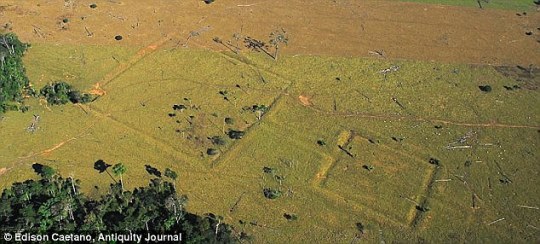
Groundbreaking Report on Ancient Amazon Civilizations That Reached Millions in Population

An international team of researchers have been investigating ancient human habitation in the Amazon. They have found that the Amazon was once inhabitated by millions of people. Eight million to fifty million may have lived there by 1492. They found that 83 native species were cultivated there. Evidence of sprawling towns that streetched for miles have been uncovered. The researchers have found extensive land management systems, towns that housed 10,000 people each, with miles of extensive agriculture around them. Giant earthworks have been uncovered, along with graveyards, canals and causeways. The activity was widespread by 3000 BCE. All throught these regions, evidence of a man made soil mix called terra preta allowed for fertile crop production. They cultivated maize, squash, Brazil nuts, palm trees and fruit. Hundreds of archaeological sites have already been found.

The Daily Mail has an extensive report here with their usual excellent series of photos and videos;
http://dailym.ai/1DFrm00

And the research was published by the Royal Society in the UK, which has the complete research report here;
http://rspb.royalsocietypublishing.org/content/282/1812/20150813

I want to thank Charles Mann who gave me the heads up on this complete report.

Mike Ruggeri’s Ancient Andean News on Tumblr
http://mikeruggerisancientandeannews.tumblr.com

Mike Ruggeri’s Ancient Andean News Magazine
http://bit.ly/1KJvVt1

July 24, 2015

Genetic Researchers Find Australian, Andaman Islands and South Pacific Genes in Some Amazon Groups

Researchers have found that some people in the Brazilian Amazon have genetic ties to the people of Australia and the South Pacific. But two different groups came to different conclusions on the results of the research. One group says that there was only one migration into the Americas around 23,000 or more years ago. And that the later South Pacific genes came from later arrivers from the Aleutians through a chain of mixing down the Pacific coast. The other group agrees that the first migrations took place 23,000 or more years ago, but from two groups and not one. This research identified a second group they call Population Y. This group is more closely related to Australian and Andaman Islanders than to the Eurasian descended Native Americans.

Both groups feel that the difference in the findings can eventually be reconciled with further gene studies

The LA Times has the story here;
http://www.latimes.com/science/sciencenow/la-sci-sn-native-american-origins-dna-20150721-story.html

And the NY Times has the story here;
http://www.nytimes.com/2015/07/22/science/tracing-routes-to-america-through-ancient-dna.html

Each paper has a few pieces of information that the other does not.

(My note; These genetic studies on the first migrations into the Americas are done by many research groups and often come to similar disagreements about the number of migrations and the dates for them. So this study will not be the last one like it. It is interesting that both groups in this study posit a date some 23,000 years ago for the first migrations into America. This places the first migrations way before Clovis times. So Pre-Clovis entry is bolstered by these two groups research. This also does not eliminate the possible entry of small groups entering before this time frame whose genes may not show up in the present studies. Remember that this study has found groups with genes not found before of South Pacific origin.)

Mike Ruggeri’s Pre-Clovis and Clovis World
http://bit.ly/11wqze5

Mike Ruggeri’s Pre-Clovis and Clovis World Magazine
http://bit.ly/1uAWdvk

Mike Ruggeri’s Pre-Clovis and Clovis News on Tumblr
http://mikeruggerispreclovisnews.tumblr.com

July 18, 2015

Tulane Archaeologists Find a New Stela and Heiroglyphic Panels in Guatemala

Tulane university archaeologists have found a stela dated to 418 CE at the site of El Achiotal in Guatemala. The stela shows an early king. And they also found two heiroglyphic panels at La Corona in Guatemala. The Maya took pains to preserve these carvings. The news was announced at a press conference in Guatemala City.

nola.com has the short report here with a photo;
http://www.nola.com/education/index.ssf/2015/07/tulane_archaeologists_discover.html

Mike Ruggeri’s Ancient Maya News on Tumblr
http://mikeruggerisacientmayanew.tumblr.com

Mike Ruggeri’s Ancient Maya News Magazine
http://bit.ly/1CeeXyu

A New Olmec Colossal Monument Found in Veracruz

A new Olmec colossal monument has been found at a ranch in Veracruz. The monument depicts an Olmec deity holding possibly an ear of corn and a load of flint. It has a headdress and a pectoral symbol. It could represent the Maize God. It weighs 10 tons. It was uncovered when the rancher was creating a dirt road. INAH wants to take the rock, but the ranchers are refusing to relinquish it. On this same ranch, there are also two Olmec pyramids. There are also petrogyphs at the site. This may be a major Olmec center, but INAH has yet to investigate the site.

costaveraceruz has the report with photos here;
http://costaveracruz.net/2015/07/13/encuentran-nuevo-monumento-colosal-olmeca-en-la-zona-sur-de-veracruz/

Mike Ruggeri’s Olmec World Magazine
http://bit.ly/1E4bDrG

July 15, 2015

4000 Year Old Village Site Uncovered in Ohio

Clay floors have been found in Ohio dating back to the late archaic at 2000 BCE. The remains indicate that this is a village site much larger than anticipated. The floors were built from layers of yellow clay. Cooking pits and storage holes for hickory nuts have been uncovered as well. They built houses covered under woven tree canopies of oak. The inhabitants were migrants from the southeast, perhaps Illinois or Kentucky. They came here several months a year to spend the fall and winter. They hunted squirrels, deers, muskrats, and fished.

Cleveland.com has the report here with a good slide show and a video;
http://www.cleveland.com/avon-lake/index.ssf/2015/07/museum_teams_unearth_4000-year.html

Mike Ruggeri’s Ancient Americas Magazine
http://flip.it/9kWYT  

July 7, 2015

Continuing Finds at the Mysterious Structure at El Pilar

The unusual structure found at the site of El Pilar in March, that had been detected by LiDAR, is now being excavated on the ground. There has been damage from looters and a lot of jungle vines that had to be cut through. They have uncovered the four terraces of the structure. The first two terraces were defensive and quarried into limestone to create vertical walls impossible to scale. The central temple at the top is oriented to the east. Several looters trenches have wreaked havoc on the structure, destroying the top of the temple and looters stole the stone that held murals. It will now be difficult to piece together the Maya plan for the site. Ceramics at the site go back to 1000 BCE-250 CE. The site of El Pilar has 2 excavated plazas and hundreds of structures over 120 acres. 20,000 people lived there. Excavations continue at the site.

Popular Archaeology has the report here with photos;
http://popular-archaeology.com/issue/summer-2015/article/mysterious-maya-citadel-begins-to-reveal-its-secrets

Mike Ruggeri’s Ancient Maya News on Tumblr
http://mikeruggerisacientmayanew.tumblr.com

Mike Ruggeri’s Ancient Maya News Magazine
http://bit.ly/1CeeXyu

ANCIENT AMERICAS LECTURES AND CONFERENCES

(DUE TO THE CANCELLATIONS OF ALL LIVE EVENTS IN THIS LOCKDOWN PERIOD, I HAVE GATHERED A LIST OF SEPTEMBER  EVENTS ON ZOOM BELOW.

AND BELOW THOSE ARE A COLLECTION OF ONLINE ANCIENT AMERICAS LECTURES, INCLUDING ONES YOU MAY HAVE MISSED ON ZOOM

 SEPTEMBER 2021 ANCIENT AMERICAS LECTURES

(MORE WILL BE ADDED THROUGHOUT THE MONTH. BOOKMARK THIS PAGE)

AND A COLLECTION OF ONLINE ANCIENT AMERICAS LECTURES, INCLUDING ONES YOU MAY HAVE MISSED ON ZOOM

Mike Ruggeri’s Ancient Americas Events on Tumblr
http://mikeruggerisevents.tumblr.com

Mike Ruggeri’s You Tube Ancient Americas Lectures

https://mikeruggerisyoutube.tumblr.com


September 13, 6:00 PM. ET

Pre-Columbian Society of NY Zoom


“Connecting the Dots: Teotihuacan’s Imperial Presence in Early Classic Mesoamerica, c A.D. 350-550”

Jesper Nielsen  Associate Professor and Head of Studies, Department of Cross Cultural and Regional Studies, University of Copenhagen

Register here:
https://docs.google.com/forms/d/e/1FAIpQLSdXVMEsUsTNXZRqd8ipIOJg1I6MoZRHnFYLMuAjGvbizqlcOQ/viewform?gxids=7628

September 15, 8:00 PM ET

Institute of Maya Studies Zoom

"A History of Ancient Maya Ancestor Veneration and Political Authority in the Mopan Valley of Western Belize”

The Zoom Link:
https://us02web.zoom.us/j/83808552653


September 16, 7:00 PM, MT

Old Pueblo Archaeological Center Zoom


Third Thursday Food for Thought Presentation: “The People behind the Petroglyphs: The Cultural Landscape of the Lower Gila River”


Anthropologist Dr. Aaron M. Wright.

To register go to https://zoom.us/webinar/register/WN_bJEZgWMbTlydBwV_lCeXqQ 


September 16, 8:00 PM ET

Aztlander presents

"A Cave For All Seasons: Agricultural and New Year Rituals at Naj Tunich Cave, Peten, Guatemala”

Barbara MacLeod

Access and bookmark this zoom hyperlink: https://us02web.zoom.us/j/82230122362


September 16, 4:00 PM MDT

The Hisatsinom Chapter of the Colorado Archaeological Society and the Crow Canyon Archaeological Center

"Tracing the Origins of Chacoan Beams”

Upon registration, an automatic e-mail will be sent to the e-mail address you provide. This e-mail will contain a link for the presentation along with connection instructions. Please double-check your address on the following registration page, and check your junk folder if you have not received an acknowledgement within 30 minutes of registering.
If you expect multiple people to watch the webinar on your device, enter how many will attend with you in the quantity box. Otherwise, enter 1.

Register here:
https://4454pp.blackbaudhosting.com/4454pp/The-Hisatsinom-Chapter-presents-Tracing-the-Origins-of-Chacoan-Beams-with-Chris-Guiterman


September 17, 1:00 PM ET

Yale Ancient Latin American Lecture

“Reflections on Arte del mar: Artistic Exchange in the Caribbean.”

Zoom Link https://yale.zoom.us/j/99632288283?pwd=U0M2SjFQYnRIYUwyZk1vY2lxbFZuZz09
  Password: 168551
  Meeting ID: 996 3228 8283
  International numbers available: https://yale.zoom.us/u/abICDLAWY


September 18, 2021, 1:30 PM ET

Pre-Columbian Society Meeting of Philadelphia Zoom

"Taking the High Ground: Lowland Maya Settlement Patterns as Seen through LIDAR”

Marcello A. Canuto is currently Director of the Middle American Research Institute and Professor of Anthropology at Tulane University.

Link here:
https://us02web.zoom.us/j/3804685493

Meeting ID: 380 468 5493


September 18-19, 2021

Pre-Columbian Society of Washington DC Symposium

“INKA EMERGENCE: EXPLORING THE ROOTS OF EMPIRE IN THE ANDES”

SYMPOSIUM OVERVIEW

In this symposium we look at what was unique about the Inka and what they owed to their precursors. Leading Andeanists have been lined up to discuss the Inka phenomenon from diverse angles in light of recent advances. They will guide us as we examine the Inka view of history and how it informed their efforts to shape Andean space and memory; what is being revealed about their Wari predecessors, especially in the Inka heartland around Cuzco, how the institutions of the Middle Horizon Wari and Tiwanaku empires persisted and how they were transformed; Wari artistic traditions and how they differed from those of the Inka; how the Inka shaped their landscape in their program of imperial domination; and how the interaction of the Andean and Amazonian world contributed to the development of Andean state societies

The interplay of these varied perspectives illuminates the differences between Inka and modern Western concepts of time and causality, and guides us back behind the received wisdom of Inka traditions as transmitted in the Spanish chronicles, to their development out of broader Andean traditions.

MEETING DATE AND TIME

This two-day virtual symposium will be held the third weekend in September on Saturday-Sunday, September 18 – 19, 2021. Each session will begin at 1:00 PM and end at 5:30 PM Eastern Time. Three different talks will be given on Saturday and three on Sunday, with discussion and question-and-answer sessions both days.

SYMPOSIUM REGISTRATION TICKET PRICES  

Each ticket entitles the registrant to stream one session of the virtual symposium. Two types of tickets are available.

GENERAL ADMISSION TICKETS      $40

These tickets are available to people who are not members of the Pre-Columbian Society of Washington, D.C. as of the day of the symposium.

MEMBER TICKETS               $30

These tickets are available to members of the Pre-Columbian Society of Washington, D.C. whose memberships are current as of the day of the symposium.

HOW TO ATTEND

You must pre-register for this event. As a confirmed registrant, you will receive a registration acknowledgment and a ZOOM link by e-mail, as well as updates as they become available. The link will enable you to logon to the Day 1 of the webinar. A separate link will be sent for Day 2.
TO PURCHASE REGISTRATION TICKETS, CLICK HERE.

If you prefer, you can print off and fill in a registration form and mail it to us. TO DOWNLOAD A REGISTRATION FORM, CLICK HERE.

September 20, 7:00 PM MT

Arizona Historical and Archaeological Society Zoom


“EARLY FORMAL CEREMONIAL COMPLEXES AND OLMEC-MAYA INTERACTION”


Takeshi Inomata and Daniela Triadan

Daniela Triadan is a professor in the School of Anthropology, University of Arizona.  She has been conducting extensive field and laboratory research in the American Southwest and Mesoamerica. Her projects in the Southwest include two large-scale studies on late prehistoric polychrome production and distribution, one centered on White Mountain Red Ware from east-central Arizona and the other on Chihuahua Polychrome from the Casas Grandes region in Chihuahua, Mexico. Her research in the Maya area included work in Belize and she co-directed the Aguateca Archaeological Project in Guatemala in the 1990s and early 2000s. Excavations of elite residential structures at the epicenter of this rapidly abandoned city revealed the richest in situ floor assemblages found to date at a Classic Maya site, providing a unique opportunity for reconstructing Classic Maya household organization. At the Guatemalan site of Ceibal and the Mexican site of Aguada Fénix she and her colleagues are investigating the processes involved in the foundation of Maya Civilization.

Register Here:
https://us02web.zoom.us/webinar/register/WN_JOJAot2USly55yhpJlB8qQ

September 21, 6:00 PM MT

Denver Art Museum Zoom ($15 for non-members)


“Recovering the History of the Fiery Tortoise Lord”


Victoria I. Lyall, Jan and Frederick Mayer Curator of Art of the Ancient Americas

Register here:

https://tickets.denverartmuseum.org/Selection.aspx?sch=313545


September 23, 6:30 PM


Walters Art Museum Live Lecture

Baltimore, Maryland

“Jewelry and Power in the Ancient Americas”


Orlando Hernandez-Ying, Adjunct Professor of Art History and Art Appreciation/Postdoctoral Curatorial Researcher at The Hispanic Society of America, NY., 

This program takes place in the Walters’ Graham Auditorium; a reception will follow.

https://thewalters.org/event/boshell-jewelry/

September 24, 7:00 PM CT

Maya Society of Minnesota Zoom


Sofía Pacheco-Forés, Ph.D.  

"Otherness, Migration, and Ritual Violence in Epiclassic Central Mexico: A Bioarchaeological Perspective”


Go here to click on Zoom link:
https://sites.google.com/a/hamline.edu/maya-society/

Thursday, September 23-26

MAYA AT THE PLAYA CONFERENCE

THE 15TH ANNUAL MAYA AT THE PLAYA CONFERENCE, WEB EDITION, WILL OCCUR FROM SEPTEMBER 23-26, 2021.

THIS YEAR’S THEME IS:

"MESOAMERICAN FOODWAYS”

NO REGISTRATION IS REQUIRED.

Zoom Link: https://davidson.zoom.us/


September 24, 1:00 PM ET

Yale Archaeological Zoom

“A Medieval Honduran Alchemy.”

Dr. Rosemary Joyce, Professor of Anthropology at the University of California Berkeley

https://yale.zoom.us/j/99632288283?pwd=U0M2SjFQYnRIYUwyZk1vY2lxbFZuZz09
Password: 168551
Meeting ID: 996 3228 8283

September 25, 9:00 AM-5:00 PM

6th Annual Rocky Mountain Pre-Columbian Association Research Colloquium LIVE

“Current Research in the Ancient Americas”  

The Rocky Mountain Pre-Columbian Association is pleased to announce its 6th annual colloquium at the Denver Museum of Nature & Science in Denver, Colorado. The event brings together an interdisciplinary gathering of scholars to address the direction of their current research projects in short, informal presentations followed by discussion.  

Ricketson Auditorium
Denver Museum of Nature & Science
2001 Colorado Blvd.
Denver, CO 80205

The conference is free and open for all to attend.
Please RSVP to  Michele.Koons@dmns.org by September 9th.  

September 30, 6:30 PM

San Diego Archaeological Society Zoom

"Cacao in Mesoamerica and South America”

Register here:
https://app.etapestry.com/onlineforms/TheSanDiegoArchaeologicalCnt/cacao.html

July 2, 2015

2000 Year Old Hopewell Ceremonial Bobcat Burial

2000 years ago, Native Americans in Illinois buried a bobcat, on the outer edge of a ceremonial mound, wearing a necklace of bear teeth and marine shells. This is the only known ceremonial burial of an animal in a cermonial mound and the only burial of a wild cat in the archaeological record. The fourteen mounds at this Hopewell site are filled with burial artifacts of animal effigies, otter shaped bowls and bird engraved ceramics. The Hopewell buried their dogs, but not in those mounds. The remains were shelved as canine bones for years until a British researcher saw the bones in 2011, and realized they were feline in nature. The report is in this issue of the Journal of Midcontinental Archaeology. The villagers may have tried to raise the bobcat, but it died young.
Due to the threatened shutdown of the Illinois State Museum, further studies have to be delayed.

Science News has the report here with a photo of the necklace;
http://news.sciencemag.org/archaeology/2015/07/ancient-bobcat-buried-human-being

Mike Ruggeri’s Adena and Hopewell World
http://bit.ly/Mj7I1L

Mike Ruggeri’s Adena, Hopewell, and Fort Ancient Cultures Magazine
http://bit.ly/1966ruf

June 30, 2015

14 Pre-Inca Tombs Found Dating From 2000 BCE 1400 CE.

Peruvian archaeologists have found 14 Pre-Inca tombs and a Moche temple dating to 2000 BCE in Lambayeque. The remains are from various periods and cultures. Most are Sican and the rest are Moche and Chimu. A gold piece for removing hair was found with a representation of the god Naylamp. Pottery, copper ornaments, silver and gilded copper birds, and other decorative objects were found in the tombs.

Peru This Week has the report here with a photo;
http://www.peruthisweek.com/news-new-pre-inca-tombs-and-mochica-temple-found-106855

Mike Ruggeri’s Ancient Andean News on Tumblr
http://mikeruggerisancientandeannews.tumblr.com

Mike Ruggeri’s Ancient Andean News Magazine
http://bit.ly/1KJvVt1

June 24, 2015

Unique Find of Ancient Metal Vessels in Chachapoyas, Peru

Two ancient metal vessels have been found in Chachapoyas in Peru. This is the first time metal artifacts have been found in this area. They could have been offerings, and will be put on display at the Museum of Chachapoyas.
According to the archaeological team, “the representations on the vessels are of two characters (male and female) carrying headdresses, are dressed in clothes with staggered and geometric designs. In every scene the two characters are joined hands, the bodies are arranged head-profile and feet. There is also a decoration points and notches in low relief that cover the environment the characters.”

Peru This Week has a report with a photo here;
http://www.peruthisweek.com/news-discovery-of-metal-vessels-will-change-the-history-of-chachapoyas-106778

And El Comercio has a more extensive report here;
http://elcomercio.pe/peru/lambayeque/hallazgo-aquillas-cambiara-historia-sobre-chachapoyas-noticia-1820632

Mike Ruggeri’s Ancient Andean News on Tumblr
http://mikeruggerisancientandeannews.tumblr.com

Mike Ruggeri’s Ancient Andean News Magazine
http://bit.ly/1KJvVt1

June 23, 2015

Long-Distance Scarlet Macaw Trade Pushed Back 150 Years

New radio-carbon dating of bird remains in a Chacoan site in New Mexico finds that long distance trade networks began 150 years sooner than thought in that area. This means that social and political hierarchies emerged sooner than thought. The trade in macaw feathers from Mesoamerica started in the 9th century, it not appears. The macaw, chocolate and turquoise trade helped facilitate the new hierarchy. The earliest dates that had been established for the Macaw trade was 1040 CE.  Two important burials at Chaco took place at 775-875 CE. And Macaw feathers were found with these burials. 30 macaw remains have been found at Pueblo Bonito, with 14 of them being found in one room, Room 38, which appears to have been an aviary. 12 of 14 macaws sampled in the new study pre-date the 1040 CE date, and half of them dated to 800-900 CE.

Popular Archaeology has the report here with great photos;
http://popular-archaeology.com/issue/summer-2015/article/scarlet-macaw-skeletons-point-to-early-emergence-of-pueblo-hierarchy

The entire research report can be read here;
http://www.pnas.org/content/early/2015/06/17/1509825112.full.pdf?with-ds=yes

And more on the long distance trade networks can be found here;

Mike Ruggeri’s The Casas Grandes World and the Turquoise Road
http://bit.ly/X1jzF9

June 23, 2015

11,000 BCE Human Footprints Found in British Columbia

Fossilized footprints of a man, woman and child radio-carbon dated at 11,000 BCE have been found on Calvert Island, British Columbia. An ancient campfire was also found nearby. Due to the sea levels being stable at this island, these footprints were not underwater. Many other sites in the general area have proofs of humans living in that area at 11,000 BCE. This is the first site in the area with human footprints dated at that time period.

(my note; I always like to add that in order for ancient peoples to be at these sites at that date range, they would have had to enter the Americas long before.)

CTV news has the report with a photo here;
http://www.ctvnews.ca/mobile/sci-tech/human-footprints-found-on-b-c-shoreline-may-be-13-000-years-old-1.2435011

Mike Ruggeri’s Pre-Clovis and Clovis News on Tumblr
http://mikeruggerispreclovisnews.tumblr.com

Mike Ruggeri’s Pre-Clovis and Clovis World Magazine
http://bit.ly/1uAWdvk

June 18, 2015

New Discoveries at the Smith Creek Sites, Mississippi

Penn State Researchers are studying are studying the transition between the Coles Creek Culture and the later Plaquemine Culture in Mississippi at the Smith Creek sites. They have found arrowheads, animal bones, pottery. Mounds at the two sites they are excavating were constructed by the Coles Creek people from 800-1000 CE. One mound was a temple foundation, another was for a burial. White sand was brought to build one layer of a mound. A human skull was found, but the neighboring tribal leaders asked that the skull not be studied or excavated. The later Plaquimine culture, who took up residence there, grew corn and amaranth, squash, pecans, sunflower seeds, fish, turtle and deer. The sites at Smith Creek show the transition between the hunting and gathering Coles Creek Culture and the sedentary Plaquemine farming culture.

The Advocate has the report here with a good slide show;
http://theadvocate.com/news/12677031-123/mississippi-valley-archaeological-site-reveals

And Penn State has a larger blog about the ongoing work at the site;
http://www.penn.museum/blog/tag/smith-creek-archaeological-project/

Mike Ruggeri’s Moundbuilders/Ancient Southwest News on Tumblr
http://mikeruggerisancientnorthamerica.tumblr.com

Mike Ruggeri’s Ancient Southwest/Mound Builders News Magazine
http://bit.ly/16PP9jH

June 17, 2015

Important Glyph Translation at Palenque

Researchers at the National Autonomous University of Mexico have deciphered the glyphs on the tomb of King Pakal at Palenque. It says “The House of the Nine Sharpened Spears.” The key was a glyph that looked like a jaguar molar which gave the connotation “edge” as in sharp edged spear. Pakal was born in 603 CE. On the wall are nine warriors with spears.

NBC News has the report here;
http://nbcnews.to/1LeOaIq

Mike Ruggeri’s Ancient Maya News Magazine
http://bit.ly/1CeeXyu

Mike Ruggeri’s Ancient Maya News on Tumblr
http://mikeruggerisacientmayanew.tumblr.com

June 14, 2015

Oldest Chihuahua Human Burial Ever Found

INAH archaeologists have uncovered the oldest human burial in Chihuahua, a boy between 12-15 years old dated at 1200 BCE. Hundreds of stone tools were also found with him, including artifacts dating back to 6000 BCE. The teeth indicate that he was part of the Bering Strait entry. 370 projectile points of basalt, obsidian, chert, flint and rhyolite ranging from 6700 BCE to 800 CE. Many of these are types found in the southwest, but not yet recorded in Chihuahua. 17,000 artifacts have been found at the site of the burial. The site was occupied for a long time. INAH gas secured the site.

INAH has the report here with a good slideshow (click on the tiny white camera icon under the cover photo).
http://bit.ly/1JOefAO

Mike Ruggeri’s Ancient Americas News on Tumblr
http://michaelruggeriancientamericas.tumblr.com

June 10, 2015

Three Caral Era Figurines Found in Peru

Three terracotta figurines depicting leaders and a priestess from the Caral civilization have been found in Peru. They date 20 1800 BCE. They were found in a basket of reeds tied with cotton. They were arranged for ,ooking at each other. Two female heads were also found wrapped in tissue, and covered with colored feathers, possibly macaw feathers.

The International Business Times has the most striking photos of these statuettes:
http://www.ibtimes.co.uk/ancient-caral-civilisation-3800-year-old-statuettes-priestess-politicians-discovered-peru-1505386

Mike Ruggeri’s Norte Chico (Peru) World Magazine
http://flip.it/YEMZZ

Mike Ruggeri’s Ancient Andean News on Tumblr
http://mikeruggerisancientandeannews.tumblr.com

June 5, 2015

Two Chavin Gargoyles Found in Chaupimarca, Pasco

Two stone Chavin era gargoyles have been found on a buried town wall in Pasco, Peru. It could show that the Chavin culture began in this area. Farmers told the researchers about the buried walls near the town. The Chavin era was 1200-200 BCE.

Peru This Week has the short report here with a good photo;
http://www.peruthisweek.com/news-two-chavin-gargoyles-found-in-chaupimarca-pasco-106545

Mike Ruggeri’s Ancient Andean News on Tumblr
http://mikeruggerisancientandeannews.tumblr.com

Mike Ruggeri’s Ancient Andean News Magazine
http://bit.ly/1KJvVt1

May 25, 2015

Advanced Trepanation Found in 1000 CE Lake Titicaca Skulls

A team of researchers working at the Copacabana Peninsula on Lake Titicaca are studying skeletons from 1000-1250 CE in the area, at the site of Ch’isi. Nine adults were found in an above ground burial chamber, and all had survived skeletal trauma. Four had blunt or sharp trauma to the face and head, seven had bodily injuries. One adult was probably beaten with a hand held mace. A female had blunt force trauma to her head, face and arms. She shows signs of trepanation or cranial surgery. Trapanation is used to relieve pressure from blood build up. The female was operated on by drilling small holes around the injury and removing bones in the middle. She survived for many years thereafter. All nine survived their injuries. The skeletons show the violent nature of life in this region at the time and the advanced state of medical knowledge. Two groups in the area were at war with one another and with the Incas as well.
Read more about the human remains from the Copacabana Peninsula in the following articles: S. Juengst and S. Chávez, “Three trepanned skulls from the Copacabana peninsula in the Titicaca Basin, Bolivia (800 BC – 1000 AD),” in the International Journal of Paleopathology. S. Juengst, S. Chávez, D. Hutchinson, and K. Mohr Chávez, “Trauma in the Titicaca Basin, Bolivia (AD 1000-1450),” in the International Journal of Osteoarchaeology.

Forbes has the report here with many good photos;
http://www.forbes.com/sites/kristinakillgrove/2015/05/25/surviving-trauma-cranial-surgery-titicaca/

Mike Ruggeri’s Ancient Andean News on Tumblr
http://mikeruggerisancientandeannews.tumblr.com

Mike Ruggeri’s Ancient Andean News Magazine
http://bit.ly/1KJvVt1

image

May 23, 2015

Above Ground Pre-Inca Tomb Found

A stone Pre-Inca burial site has been found near Chimbote, Peru. This is the first Pre-Inca above ground tomb it is believed. There is a portico with three compartments inside.

PeruThisWeek has the short report with a photo;
http://www.peruthisweek.com/news-new-pre-inca-tomb-discovered-106319

Mike Ruggeri’s Ancient Andean News on Tumblr
http://mikeruggerisancientandeannews.tumblr.com

image

May 23, 2015

Above Ground Pre-Inca Tomb Found

A stone Pre-Inca burial site has been found near Chimbote, Peru. This is the first Pre-Inca above ground tomb it is believed. There is a portico with three compartments inside.

PeruThisWeek has the short report with a photo;
http://www.peruthisweek.com/news-new-pre-inca-tomb-discovered-106319

Mike Ruggeri’s Ancient Andean News on Tumblr
http://mikeruggerisancientandeannews.tumblr.com

May 21, 2015

Cannibalism in Mesoamerica Cooking Techniques

At the site of Tlatelcomila, near Mexico City, the human bones of 18 men, women and children, dated to 700-500 BCE, show signs of cannibalism. Flesh was cut from their bones and their bones were broken at the time of death. Many of the boness had a yellow or red tinge to them. Researchers used powder x-ray diffraction, scanning electron microscopy, transmission electron microscopy, atomic force microscopy, and ultraviolet visible spectroscopy to take a close look at the bones. They found the bones had been cooked by grilling and boiling. The reddish color is from blood, but the boiled bones were cooked with chilis.
Trujillo-Mederos and colleagues’ full article, “Savoury recipes and the colour of the Tlatelcomila human bones,” can be found in early view at the journal Archaeometry.

(My note; The evidence of cannibalism at this site has been known for years. This is the first study to determine how the remains were cooked).

Forbes has the report here;
http://www.forbes.com/sites/kristinakillgrove/2015/05/20/ancient-mesoamerican-recipe-for-cooking-human-flesh-stuns-archaeologists/

A report from a few years back posted in Art Daily was about evidence of cannibalism in Tenochtitlan;
http://artdaily.com/index.asp?int_sec=11&int_new=67523#.VV11vmBkjR7

Mike Ruggeri’s Mesoamerica News on Tumblr
mikeruggerismesoamericanews.tumblr.com

image

May 19, 2015

New Early Moche Temple and Other Discoveries in Peru

A Peruvian team is excavating at Moche sites in the Mata Indio zone in Peru. They have found a temple with 30 drawings. The team is looking to find smaller temples connecting the borders between the valley and the desert. Pre-Moche artifacts found there go as far back as 1500 BCE. A Moche era temple, dated at 200-300 CE, painted white and yellow with paintings has been uncovered. The site covers 6,700 acres

Latino Fox News has the report here;
http://latino.foxnews.com/latino/entertainment/2015/05/18/archaeologists-seek-to-unveil-mysteries-peru-mochica-culture/

And in a follow up story, Peru this week reports that the temple dates back to earliest Moche times. Two smaller mounds have been found with evidence of various occupations. Evidence of roads used to cross the desert have been uncovered. A good photo of the temple excavation included.
http://www.peruthisweek.com/news-lambayeque-temple-found-in-cerro-mato-indio-106252

Mike Ruggeri’s Ancient Andean News on Tumblr
http://mikeruggerisancientandeannews.tumblr.com

Mike Ruggeri’s Ancient Andean News Magazine
http://bit.ly/1KJvVt1

image

May 19, 2015

New Early Moche Temple and Other Discoveries in Peru

A Peruvian team is excavating at Moche sites in the Mata Indio zone in Peru. They have found a temple with 30 drawings. The team is looking to find smaller temples connecting the borders between the valley and the desert. Pre-Moche artifacts found there go as far back as 1500 BCE. A Moche era temple, dated at 200-300 CE, painted white and yellow with paintings has been uncovered. The site covers 6,700 acres

Latino Fox News has the report here;
http://latino.foxnews.com/latino/entertainment/2015/05/18/archaeologists-seek-to-unveil-mysteries-peru-mochica-culture/

And in a follow up story, Peru this week reports that the temple dates back to earliest Moche times. Two smaller mounds have been found with evidence of various occupations. Evidence of roads used to cross the desert have been uncovered. A good photo of the temple excavation included.
http://www.peruthisweek.com/news-lambayeque-temple-found-in-cerro-mato-indio-106252

Mike Ruggeri’s Ancient Andean News on Tumblr
http://mikeruggerisancientandeannews.tumblr.com

Mike Ruggeri’s Ancient Andean News Magazine
http://bit.ly/1KJvVt1

May 19, 2015

Ancient Bolivian Gruesome Skull Finds

Researchers at the 200-800 CE site of Wata Wata in Bolivia have found three skulls of people who had been beaten, beheaded and deflated. One was male and two females. They all had cranial deformation and all the skulls showed chops, cuts, scrapes and fractures on their skulls at time of death. The female was scalped and had her eyes gouged out. The male was bludgeoned and eyes gouged out. The 2nd female also suffered a similar fate. Eye removal was a common form of torture in the Ancient Andes. The deaths may have symbolized a new regime had taken power.
(my note; cranial deformation was usually reserved for higher born individuals).
The research was published in Latin American Antiquity.
(This research by Becker and Alconini, “Head extraction, interregional exchange, and political strategies of control at the site of Wata Wata, Kallawaya Territory, Bolivia, during the transition between the Late Formative and Tiwanaku Periods (A.D. 200-800),” published in the journal Latin American Antiquity, was funded in part by the National Science Foundation and the Wenner-Gren Foundation for Anthropological Research.)

Forbes has the report here;
http://www.forbes.com/sites/kristinakillgrove/2015/05/17/gruesome-evidence-of-political-torture-found-on-precolumbian-skulls/

Mike Ruggeri’s Ancient Andean News on Tumblr
http://mikeruggerisancientandeannews.tumblr.com

Mike Ruggeri’s Ancient Andean News Magazine
http://bit.ly/1KJvVt1

May 18, 2015

Ancient Gaming Artifacts Found in Utah Cave

Researchers exploring what is named Cave 1 in Utah have found dice, hoops, carved sticks and other artifacts related to gambling. They project they will find 10,000 more artifacts of this kind in the cave. The cave has already yielded butchered bison and elk bones and hundreds of moccasins. The artifacts date to the late 1200’s CE. The culture that lived there is called the Promontory Culture. These people left the Canadian Subarctic to migrate to the Southwest. Despite the turmoil and abandonment that was taking place at other sites at this time, the Promontory Culture was thriving. Dice was probably largely a womens game for personal property or chores. Men’s gambling was often a replacement for hostility between rival groups. Games were probably played with the nearby Fremont people. There are stories of men losing everything, food, their clothes, and losing their family as slaves, even their own scalps. There is a die made from a beaver tooth that came from the Oregon coast, indicating wide spread trade relationships. A spiral incised stick is similar to ones found in British Columbia. Many of the artifacts bear the imprint of their Arctic origins.

Western Digs has a very complete report with many photos here;
http://westerndigs.org/dice-gaming-utah-cave-prehistoric-gambling/

Mike Ruggeri’s Moundbuilders/Ancient Southwest News on Tumblr
http://mikeruggerisancientnorthamerica.tumblr.com

Mike Ruggeri’s Ancient Southwest/Mound Builders News Magazine
http://bit.ly/16PP9jH

image

May 13, 2015

53 Ancient Burials Uncovered in Peru

Fifty three burials belonging to the Ychsma Culture have been uncovered at Huaca Mateo Salado in Peru. A ceremonial staircase has also been found decorated in ocher. They were placed in circular holes. Vertical rods kept the burials upright. Some heads were covered with bags with simulated eyes and mouths of seed, shells and plates. Offerings in the graves were vessels, textiles, agricultural implements. Work will continue on unexcavated pyramids, roads and walls.

Andina has the report here (in Spanish) with a good slide show;
http://www.andina.com.pe/agencia/noticia-mas-medio-centenar-entierros-prehispanicos-encuentran-huaca-mateo-salado-555904.aspx

Mike Ruggeri’s Ancient Andean News Magazine
http://bit.ly/1KJvVt1

image

May 13, 2015

53 Ancient Burials Uncovered in Peru

Fifty three burials belonging to the Ychsma Culture have been uncovered at Huaca Mateo Salado in Peru. A ceremonial staircase has also been found decorated in ocher. They were placed in circular holes. Vertical rods kept the burials upright. Some heads were covered with bags with simulated eyes and mouths of seed, shells and plates. Offerings in the graves were vessels, textiles, agricultural implements. Work will continue on unexcavated pyramids, roads and walls.

Andina has the report here (in Spanish) with a good slide show;
http://www.andina.com.pe/agencia/noticia-mas-medio-centenar-entierros-prehispanicos-encuentran-huaca-mateo-salado-555904.aspx

Mike Ruggeri’s Ancient Andean News Magazine
http://bit.ly/1KJvVt1

May 10, 2015

Earliest Art Work in Alaska Found?

Archaeologists in Alaska have found a bone pendants with cross hatching that is dated to 12,300 years ago. This may be the earliest art work ever found in Alaska. Earlier, teams working nearby at the Upward Sun River site found three Ice Age infant/child burials. They are now expanding digging in this area. Bone fragments that may have been on their way to being made into art work and a brown bear jawbone were also found. The artifacts in the area are protected by layers of fine dust called loess which blows off glaciers.

Sitnews has the story here with photos;
http://www.sitnews.us/0515News/050715/050715_ak_science.html

(The reports on the earliest Alaskan Ice Age burials are here)
http://phys.org/news/2011-02-scientists-oldest-sub-arctic-human.html
http://uafcornerstone.net/oldest-subarctic-north-american-human-remains-found/

Mike Ruggeri’s The Ancient America’s Breaking News
http://bit.ly/UbLO7x

May 8, 2015

New Research at the Moorhead Circle

New research published in “Building the Past: Prehistoric Wooden Post Architecture in the Ohio Valley — Great Lakes” edited by Brian Redmond and Robert Genheimer includes new research on the Moorhead Circle, the center of the Fort Ancient Earthworks built 2000 years ago. The entrance to the circle was through a gap in a ring of posts paved with limestone slabs. Older pavements are below it. There is a central pit filled with blood-red clay. And there is a central structure 50 feet long and 40 feet wide which may have been a ritual sanctum. There are concentric rows of 15 trenches filled with gravel and sand, which may have been for an audience. The circle went through a sequence of termination rites, and the large posts around the site were removed at 150 CE. The main structure was in use till 250 CE, and then was buried under tons of gravel. The Hopewell must have believed that these sanctums contain enormous power and it takes enormous efforts to terminate them.
(my note, through the Ancient Americas, ritual termination of sites and structures is a recurring phenomena).

The great Bradley Lepper has the report here;
http://www.dispatch.com/content/stories/science/2015/05/03/1-author-examines-ceremonial-heart-of-earthworks.html

Mike Ruggeri’s Adena, Hopewell, and Fort Ancient Cultures Magazine
http://bit.ly/1966ruf
(click on titles or pictures to open articles)

May 6, 2015

Post-Teotihuacan La Quemada Research

Archaeologists researching the site of La Quemada looked at bones dated from 500-900 CE. They found that the remains of those killed outside the main compound were treated in a violent fashion. Bones inside the compound were treated with respect. Those outside were abused and showed signs of cannibalism. After the collapse of Teotihuacan, the northern frontier was in upheaval. The bones of enemies were splintered, burned, and some were hung by way of holes bored into their skulls.
More information: Symbolic bones and interethnic violence in a frontier zone, northwest Mexico, ca. 500–900 C.E. Ben A. Nelson, DOI: 10.1073/pnas.1422337112

Phys.org has the report here;
http://phys.org/news/2015-05-bone-analysis-reveals-violent-history.html

Mike Ruggeri’s Casas Grandes World Magazine
http://bit.ly/1ztd8vF
(click on titles or pictures to open articles)

May 5, 2015

Floods at Cahokia May Have Doomed the City

New evidence at Cahokia taken from lake bottom sediment cores dating back 2000 years show evidence of eight major floods in the central Mississippi river valley. Cahokia became a major metropolis during an arid and flood free period. The research team collected cores from two lakes to see if the information was consistent. By 900 CE, people in the Cahokia area were cultivating maize and the population exploded. Larger buildings and structrues were constructed. But at 1200 CE, there was a major flood and a population decline. A defensive wall was built around Cahokia and other material changes. By 1400 CE, Cahokia was deserted. The cores show a rise in the Mississippi by 33 feet above base elevation, which would have flooded out crops and food stores.
The research is published in the Proceedings of the National Academy of Sciences.

Popular Archaeology has the report here;
http://popular-archaeology.com/issue/spring-2015/article/cahokia-s-rise-and-fall-linked-to-river-flooding

Mike Ruggeri’s Ancient Southwest/Mound Builders News Magazine
http://bit.ly/16PP9jH

May 4, 2015

New Research on the Nazca Lines

Researchers from Yamagata University in Japan believe that the Nazca lines were made by two different groups taking pilgramage routes to an ancient temple. The lines were drawn between 200 BCE-600 CE. The Yamagata team has uncovered 100 geoglyphs and broken ceramics at the intersection of two lines. The lines led to the vast pre-Inca temple complex at Cahuachi. Images of animals were found along a route starting from the Ingenio River. They continue on a path to Cahuachi. Images of trophy heads and supernatural beings were concentrated in the Nazca Valley and went towards Cahuachi. A third group was found on the Nazca Plateau. Even after Cahuachi collapsed, trapezoids and straight lines continued to be made and used.
The research was presented at this year’s Society of American Archaeology Conference in San Francisco.

Live Science has the report here;
http://www.livescience.com/50699-nasca-lines-ritual-procession.html

Mike Ruggeri’s Ancient Andean News Magazine
http://bit.ly/1KJvVt1
(click on titles or photos to open articles)

April 30, 2015

Maya Site in Guatemala Found with Grid Design

Archaeologists at the Maya site of Nixtun-Ch’ich in Guatemala, dated at 600 BCE-300 BCE, have found that the city was built on a grid design. A powerful ruler had to have commanded this design. While Teotihuacan was also built on a grid plan, so far, no connection has been found between the two cities. The main ceremonial route runs east-west. 15 buildings were in an exact straight line, including flat topped pyramids. At The end of the street is a triadic structure similar to those found in other Maya cities. The residential area followed a north-south axis. A defensive wall protects the city. Cattle ranchers in the area are guarding against looters.

Live Science has the report here with a photo;
http://www.livescience.com/50659-early-mayan-city-mapped.html

Mike Ruggeri’s Ancient Maya News Magazine
http://bit.ly/1CeeXyu
(click on titles or pictures to open articles)

April 30, 2015

Maya Site in Guatemala Found with Grid Design

Archaeologists at the Maya site of Nixtun-Ch’ich in Guatemala, dated at 600 BCE-300 BCE, have found that the city was built on a grid design. A powerful ruler had to have commanded this design. While Teotihuacan was also built on a grid plan, so far, no connection has been found between the two cities. The main ceremonial route runs east-west. 15 buildings were in an exact straight line, including flat topped pyramids. At The end of the street is a triadic structure similar to those found in other Maya cities. The residential area followed a north-south axis. A defensive wall protects the city. Cattle ranchers in the area are guarding against looters.

Live Science has the report here with a photo;
http://www.livescience.com/50659-early-mayan-city-mapped.html

Mike Ruggeri’s Ancient Maya News Magazine
http://bit.ly/1CeeXyu
(click on titles or pictures to open articles)

April 24, 2015

New Mysterious Finds in Teotihuacan Tunnel

INAH archaeologist Sergio Gomez has found a surprise at the tunnel underneath Teotihuacan’s Pyrmaid of the Plumed Serpent. They have found a large quantity of mercury at the end of the tunnel sealed for 1,800 years. Maybe it was placed there as a symbolic underworld river or lake. Merecury has been found at a few Maya sites. They are still very slowly tunneling to three chambers which may hold the resting place of an elusive Teotihuacan king. Gomez has been excavating there for 6 years, and is slowed by humidity, mud, and now potential mercury poisoning. Linda Manzanilla doubts there was ever a single king, but a ruling council, given the lack of a single palace or depictions of kings in any Teo murals. The excavation should be complete by October.

Business Insider has the story here, and more reports of this find will be popping up online.

http://www.businessinsider.com/r-hunt-for-ancient-royal-tomb-in-mexico-takes-mercurial-twist-2015-4

Mike Ruggeri’s Teotihuacan; City of the Gods Magazine
http://bit.ly/1z57bpL

(click on titles or pictures to open articles)

April 21, 2015

New Finds on the Maya Collapse in the South

A team from Yale and other universities looked at climate data in the southern and northern Maya lowlands. The collapse of the Maya in the south from 800-950 CE was partly due to more severe drought in the south. They studied stable hydrogen and carbon isotope analyses of plant wax lipids in sediment cores taken from Lakes Chichancanab and Salpeten, in the northern and southern Maya Lowlands, respectively. They found that the south had more intense drying which led to societal decline in the south. They also found a period of intense drying in the Early Classic (200-500 CE) leading to some larger sites being abandoned and political fragmentation taking place. Teotihuacan entered the area, leading to political re-alignment.
The research is published in the Proceedings of the National Academy of Sciences
*Peter M. J. Douglas, et al., “Drought, agricultural adaptation, and sociopolitical collapse in the Maya Lowlands,” Proceedings of the National Academy of Sciences, www.pnas.org/cgi/doi/10.1073/pnas.1419133112

Popular Archaeology has the report here:
http://popular-archaeology.com/issue/spring-2015/article/new-findings-on-drought-and-the-ancient-maya-collapse

Mike Ruggeri’s Ancient Maya News Magazine
http://bit.ly/1CeeXyu
(click on titles or pictures to open articles)

Proof of Ancient Asia/Alaska Trade Discovered

April 17, 2015

Archaeologists have found bronze artifacts dated at 1000 CE at the Rising Whale site in Alaska. This is further proof that ancient trade was happening between Asia and the Americas at this very early date. One of the bronze artifacts is dated at 600 CE. The bronze would have had to come from Yakutia, China, or Korea. Obsidian from Russia was also found. The trade may have been facilitated by the “Bernick” culture, who lived on both sides of the Bering Strait. They are the ancestors of the “Thule” who went as far as Greenland. The Thule are ancestors of the modern Inuit.
The team will present their research on the Rising Whale site at the Canadian Archaeological Association annual meeting in St. John’s Newfoundland, Canada, between April 28 and May 2.

Live Science has the story here;
http://www.livescience.com/50506-artifacts-reveal-pre-columbus-trade.html

April 16, 2015

Wally’s Beach, Alberta Pre-Clovis

University of Calgary researchers are investigating the site of Wally’s Beach in Alberta. The tracks and bones of extinct animals, and stone tools were uncovered when the area was drained. The objects were dated at 13,000 years old on the first investigation in 1999. A new investigation has found that the artifacts are 300 years older, putting them into the Pre-Clovis category.

Brian Kooyman, one of the researchers, said that evidence of hunting horses was found there. They found the footprints of mammoths and camels. The new and more advanced dating methods in use today found the artifacts at Wally’s Beach were Pre-Clovis in date. The Clovis period in Calgary began 12,000 years ago. This site shows the beginnings of large scale hunting in the Americas as a prelude to the Clovis culture.
(my note: Of couse, it took a long time before 13,300 years ago for these hunters to reach Alberta. They would have had to leave Asia at an even earlier time).

The Calgary Herald has the news here;
http://calgaryherald.com/news/local-news/q-a-with-brian-kooyman-on-the-wallys-beach-site

April 11, 2015

Hundreds of Peruvian Mummies Found at the Site of Tenahaha

Dozens of tombs with up to 40 mummies dated to 800 CE each have been found in Peru. The site will be called Tenahaha. The tombs were placed on hills overlooking the living. The corpses range in age from fetuses to older adults. Some of the mummies were intentionally broken apart and scattered between the tombs. This may have been a community binding ritual for the dead. Between 800-1000 CE was a time of upheaval and conflict in Peru. But at Tenahaha, the pottery was not warlike, as was found in other areas, but showed people smiling. Perhaps Tenahaha was neutral ground for feasting and burying the dead. An international team has been involved in the excavations at the site.
Live Science has the report here, with photos;
http://m.livescience.com/50415-dozens-of-mummies-discovered-in-peru.html

April 8, 2015

New Discoveries on the Fort Ancient Culture

The Fort Ancient Culture of Ohio, Kentucky, Indiana and West Virginia had a rapid increase in maize production, and then declined.  Researchers carried out isotopic analysis of human teeth from burials dated at 1000 CE onwards. There was an influx of Mississippian peoples in the area, spreading Mississippian agricultural and cultural traditions to the east. Mississippian style housing and ceramics have been found at Fort Ancient sites.
The study is been published in the Journal of Archaeological Science.
*Cook, Robert A. and Price, T. Douglas, Maize, Mounds and the Movement of People: Isotope Analysis of a Mississippian/Fort Ancient Case, Journal of Archaeological Science, doi:10.1016/j.jas.2015.03.022
Popular Archaeology has the report here;
http://bit.ly/1DixePM

April 2, 2015

The Beginnings of Agriculture in the Caribbean Pushed Back by 1000 years.

A team of Cuban and Canadian researchers examined the shell-matrix site of Canimar Abajo in Cuba. They studied dental calculus, human bone collagen carbon and nitrogen isotopes. They found that ancient Caribbeans used cultivated plants 1000 years earlier than thought. The commonly accepted date for cultivation was 500 CE. The new study pushes this date back to 990-800 BCE. At this earlier date, beans, sweet potatoes and the toxic plant zamia was cultivated. The same research will now be extended to other Caribbean sites.
Their findings* were published in the Journal of Archaeological Science.
*Y. Chinique de Armas, et al.,Starch analysis and isotopic evidence of consumption of cultigens among fisher-gatherers in Cuba: the archaeological site of Canímar Abajo, Matanzas, Journal of Archaeological Science, doi:10.1016/j.jas.2015.03.003
Popular Archaeology has the report here;
http://popular-archaeology.com/issue/spring-2015/article/scientists-discover-early-food-production-in-caribbean

March 26, 2015

Mysterious New Structure Found at the Maya site of El Pilar

Archaeologist Anabel Ford has found a new kind of Maya structure at the site of El Pilar on the Guatemala/Belize border. she is calling “the Citadel.” It shares nothing in common with other Maya structures. The structure was detected by LIDAR. The structure contains concentric terracing and four temples. It is isolated from the rest of the El Pilar site. It is a mystery as to its origins, when it was built and its purpose. Why is it isolated? It could be an early Pre-Classic site or a post-Classic site when defensive fortifications were constructed. The terracing and high location points to a defensive structure.
Popular Archaeology has the report here with great photos;
http://popular-archaeology.com/issue/spring-2015/article/archaeologist-discovers-mysterious-ancient-maya-citadel
More on Ford’s work at El Pilar can be found here;
http://popular-archaeology.com/issue/09012013/article/seeing-through-the-canopy

March 25, 2015

New Research on Aztec-Tlaxcallan Obsidian Sourcing

A team of researchers from North Carolina State University, the Centro de Investigación y de Estudios Avanzados del Instituto Politécnico Nacional-Unidad Mérida, El Colegio de Michoacán and Purdue University have been studying the independent republic of Tlaxcallan during the Aztec era. They focused on obsidian sources for Tlaxcala. The Tlaxcallan obsidian was mostly obtained from a source at El Paredon, just near the Aztec frontier. Why didn’t the Aztecs intervene to block that source from their Tlaxcallan enemy? Probably because the time and effort involved would not have been worth it, since other sources were available. The researchers used x-ray fluorescence on obsidian from Tlaxcallan and compared that to other obsidian sources in the area, including the Aztec’s main source at Pachuca.
The paper, “The Geopolitics of Obsidian Supply in Postclassic Tlaxcallan: A Portable X-Ray Fluorescence Study,” was published online March 25 in the Journal of Archaeological Science.

Archaeology.org has the report here;http://www.archaeology.org/news/3116-150325-obsidian-blade-tlaxcallan

March 24, 2015

Pre-Clovis Hunting in Alberta

New advanced radiocarbon dating has found that Ancient Americans hunting extinct horse and camel species at Wally’s Beach, Alberta were hunting 300 years before the beginning of the Clovis era. 27 new radiocarbon dates verify this assertion.
The finds add to the knowledge that humans were hunting mammoth, mastodon, sloth, and gomphothere species for 2000 years before these species became extinct.
The research was reported in the *Article #14-20650: “Late Pleistocene horse and camel hunting at the southern margin of the ice-free corridor: Reassessing the age of Wally’s Beach, Canada,” by Michael R. Waters, Thomas W. Stafford, Jr., Brian Kooyman, and L. V. Hills.
Source: Adapted and edited from the PNAS press release, Large mammals hunted by prehistoric humans
(my note: It is also always good to remember that it would have taken a long time for these ancient Americans to arrive at places like Alberta, so they would have had to leave Asia long before the Clovis era began.)
Popular Archaeology has the report here;
http://popular-archaeology.com/issue/spring-2015/article/horse-and-camel-hunting-by-prehistoric-humans-in-north-america

March 23, 2015

Pre-Inca Baby Mummy Found in Lima

A pre-Inca baby mummy was found on the outskirts of Lima along with dozens of other mummified remains when experts combed the hills preparatory to building a new road. It is on the edge of the largest Inca cemetery ever found. 2000 mummies have been uncovered there so far, along with ceramics, textiles, silver, copper and gold
The Daily Mail has the report here with their usual very great photos of the find;
http://dailym.ai/19exSBq

March 17, 2015

The End of Teotihuacan

Linda Manzanilla, who has been one of the principle archaeologists at Teotihuacan for decades, has been studying the Teotihuacan neighborhood of Teopancazco. She studied excavated individuals for measurements of activity markers, nutritional patterns and status, isotopes, and ancient DNA. Groups with different backgrounds settled on the margins of the city.  Elites in the city core controlled the trade in pigments, cosmetics, slate, greenstone, travertine, and foreign pottery, and acquired workers foreign cultures to perform specialized tasks. Tensions between the leaders of Teotihuacan and the competitive intermediate elites grew. These tensions resulted in revolt and the destruction of Teotihuacan in 550 CE. No foreign invasion traces have been found at the site at this time. The state may have tried to intervene to quell the tensions leading to the final revolt, the burning of the city, and the shattering of elite residences. The society was too fractured and complex to survive these tensions.
The report is published in the Proceedings of the National Academy of Sciences.
Popular Archaeology has the report here;
http://popular-archaeology.com/issue/spring-2015/article/ancients-set-stage-for-collapse-of-teotihuacan

March 10, 2015

Olmec Artifact Find in Veracruz

A mottled brown and white jadeite artifact dated to 900-400 BCE has been uncovered from the underwater site of Arroyo Pesquero in Veracruz. There are glyph like designs on it. The design is Olmec in style, and it comes from the Olmec era, and the site is 10 miles from the Olmec site of La Venta. The design and iconography look like they are related to corn. It may have served as the base of a bloodletter or a ruler bar. Thousands of offerings have been excavated from the site. The site is a place where fresh water and salt water converged, and in the Olmec land of stagnant swamps, fresh water sources would have been sacred, and offerings made as a result.
LiveScience has the report here with a photo of the artifact;
http://www.livescience.com/50080-mysterious-jade-artifact-discovered-in-mexico.html
A site project web site
http://anthro.fullerton.edu/Pesquero/
Some of the iconography of artifacts from the site
FAMSI © 1999: Frank Kent Reilly, III
Olmec-style Iconography
http://www.famsi.org/reports/94031/94031Reilly01.pdf

March 6, 2015

Possible Pre-Clovis tool found in Oregon Rock Shelter

Archaeologists have uncovered a scraper chipped from orange agate at the Rimrock Rock Shelter in Oregon. It was found under volcanic ash, 12 feet below the surface from Mount St. Helen’s, that has been dated at 15,000 years ago. If this date holds up, it will be another Pre-Clovis dated find from Oregon, with the Paisley Cave site as the other Pre-Clovis site, and where DNA evidence, tool evidence and stratigraphy evidence shows proof of Pre-Clovis activity at the site. The problem with this Rimrock Shelter find is that it has not yet been published in a peer reviewed journal, nor been subjected to outside research. And the chipped agate has to have been shown to have not slipped down through the ash layers so that it is not really as old as the ash covering at that depth.
(my note; So this find is not in the same league as the proven Pre-Clovis finds at Monte Verde, Chile or Paisley Cave, Oregon. The Monte Verde finds have withstood the test of time. Numerous tests have been done on the stratigraphy layers where human artifacts were found by many outside groups. None of these groups diputed those finds after testing. The fabric material, tools, footprints and housing posts also have undergone testing over time, and the dates continue to show Pre-Clovis in time. The human DNA found on human chewed seaweed at the site also correlates with the Pre-Clovis dates proven so far. Unless all scientific testing is totally faulty, Monte Verde is proven Pre-Clovis. And if all scientific testing and peer group testing is faulty, then archaeologists cannot date anything correctly. The Monte Verde dates are as proven as any dates proven in the field. At Paisley Cave, human coprolites were found and dated at Pre-Clovis. The stratigraphy layer of the tools has been verified at Pre-Clovis. The Paisley Cave finds are not as old as Monte Verde, so there will be more peer group testing at that site.)
Fox News printed this AP report, with a photo of the agate;
http://www.foxnews.com/science/2015/03/06/excavation-at-oregon-site-unearths-ancient-stone-tool/

February 25, 2015

New Discoveries on the Most Ancient Human Remains in Texas

A man and girl were buried at the Horn Shelter Site in Texas 11,100 years ago. Smithsonian is analyzing the bones and grave goods, and Harvard is looking at the DNA. The 40 year old male had a medicine bundle of red ochre pigment, seashells, badger claws, hawk talons, turtle shells. His arms appear to be those of a drummer. The 11 year old girl may have been sacrificed to accompany the shaman into the afterlife. The turtle shells were placed over the man’s face and under his head, and the grave is in the shape of a turtle. There is a sharpened coyote tooth used for scarification. The skeletons were found in 1970.
(My note; This is one of the frustrations on dealing with the ancestry of ancient Americans, it takes so long for studies to commence. Only now, after 44 years are DNA and other extensive studies being done on the earliest bodies ever found in Texas.)
The WacoTrib has the story with photos here;
http://www.wacotrib.com/news/higher_education/smithsonian-sheds-light-on-shaman-and-girl-buried-on-the/article_fec2b8c9-e100-5082-a1e1-5791025981f3.html?mode=jqm

February 24, 2015

Ancient De-Fleshing of Human Corpses in Ancient Bolivia.

Archaeologists have found an ancient mortuary in Bolivia at the site of Khonkho Wankane, where corpses were defleshed and cleaned to carry in pieces. The bodies were boiled in pots of quicklime. The human remains were found in a circular building where there were 1000 teeth and small bones sheathed in white plaster. Ceramics and tools made from llama bones were also in white plaster. Blocks of quicklime were found for the use of defleshing the bones. Body parts were found in this substance, and carvings on a pillar show a human with defleshed ribs. The site was in use for 400 years. Since small bones remain there, the big bones were probably carried away. In this area, the dead were often disinterred for rituals and consultation. The people that stopped at the site were itinerant llama drivers who took the dead on the road with them.
The research is published in the journal Antiquity.
USA Today has the report here with a photo;
http://www.usatoday.com/story/experience/food-and-wine/news-festivals-events/2015/02/22/mortuary-andean-mountain-ancient-chile/23715911/

February 23, 2015

Two Remarkable Wooden Sculptures Found in Ancient Chimu Tomb

Archaeologists have found two wooden sculptures in a Chimu tomb in Peru. They are of male musicians. They once wore copper masks. The flutes they carry are identical to the 16 bamboo flutes that were also found in the tomb, along with woven cloth and pottery. One pottery vessel depicted the Chimu goddess of the moon, weavers and the sea. the tomb may have belonged to noble musicians and weavers. The wooden sculptures may represent a last musical ceremony actually held for the departed in the tomb.
Archaeology.org has the report here with a photo of the wooden sculptures;
http://www.archaeology.org/issues/128-1403/artifact/1732-artifact-chimu-musical-funerary-idols

February 22, 2015

More Surprises in a Maya Mural at the Site of Xultun, Guatemala

A mural found in 2010 by a grad student at the site of Xultun in Guatemala, dated to 750 CE, shows intellectuals conversing with a royal governor dressed as the wind god.The mural also gives information about a man buried beneath him. The area below was excavated and the man’s skeleton was uncovered dressed like one of the men in the mural. William Saturno excavated further and found a mural of a king in a blue feathered headdress with a man kneeling before him who was called junior obsidian. Behind them, on another wall, are three black clad men, one who is called senior obsidian. They wear the same headdress and clothing. The murals surprisingly are painted in the residence of a court official and not of royalty. This and much more interpretation of the three walled mural has been published in the February issue of Antiquity.
Live Science has the report here with illustrations of the murals;
http://www.livescience.com/49855-obsidian-maya-mural-guatemala.html

February 15, 2015

New Ideas on the Hopewell Interaction Sphere

Bradley T. Lepper is looking at the Hopewell Interaction Sphere to try and understand its main components. The Interaction Sphere is primarily a mortuary-ceremonial and religious interaction sphere. Lepper now believes that the Interaction Sphere is primarily a network of pilgrimage centers. Followers brought exotic raw materials and finished craft items to places like the Hopewell Mound Group and the Newark Earth Works. The pilgrims would return home to spread the religious ideas and establish local centers for the main religious ideas to be promulgated. They would bring home bladelets made from Ohio flint ridge material as tokens of visitation.
Research is showing that Ohio Flint Ridge flint bladelets were an important symbol of the Hopewell Interaction Sphere. At Pinson Mounds in Tennessee, 25% of the bladelets found there were from Flint Ridge, Ohio. And another 20% possibly from Flint Ridge. At Ohio sites, the Flint Ridge bladelets dominate. Flint Ridge flint declined at the end of the Hopewell era.
Bradley Lepper’s excavations at Flint Ridge showed that it was quarried on an industrial scale and turned into bladelets. The quantity produced was far greater than local need. Lepper believes that they were made to distribute as souvenirs and pilgrims tokens rather than part of a trade network. They were valuable symbols of the pilgrimage to the large Hopewell sites. And the industry died when the Hopewell era ended even though the bladelets were very efficient and well made, as if the system of belief that supported their use had died.
To further develop the idea of pilgrimages and the transportation of exotic finished products to the main sites, Wright and Loveland published their research at the site of Garden Creek recently in the journal Antiquity. The Hopewell site of Garden Creek in North Carolina has three mounds and earthen enclosures. Fragments of mica and crystal quartz have been found there dating to the Hopewell era. The mica and quartz was probably shaped by craftsmen there into trade objects. But no finished pieces are found there, indicating the pieces were sent away exported. The finished products may have been taken to the great Ohio Hopewell sites as an act of religious devotion.
Bradley Lepper’s reports are here;
http://apps.ohiohistory.org/ohioarchaeology/the-hopewell-mortuary-ceremonial-interaction-sphere/
and here;
http://www.dispatch.com/content/stories/science/2015/02/15/01-theory-looks-at-how-ancient-goods-got-to-ohio.html
and here;
http://www.dispatch.com/content/stories/science/2014/12/07/01-flint-tool-disappeared-with-hopewell-culture.html

February 14, 2015

The Diet of 2000 Year Old Individuals in Peru Has Been Uncovered.

University of Arizona researchers are using bioarchaeology and biogeochemistry to study the diets of 14 individuals dating back almost 2,000 years. They are studying mummies from the Paracas Necropolis of Wari Kayan. Using hair samples, they found what these individuals ate near the time of their deaths. They ate primarily marine products, maize and beans. The mummies were discovered in 1927 in seated positions, wrapped in bundles of textiles. The researchers plan to do more isotopic analysis of other mummies to build their understanding.

Phys.org has the report here;

http://phys.org/news/2015-02-isotopic-analysis-explore-ancient-peruvian.html

And the full technical research report is online for free at the Journal of Archaeological Science,
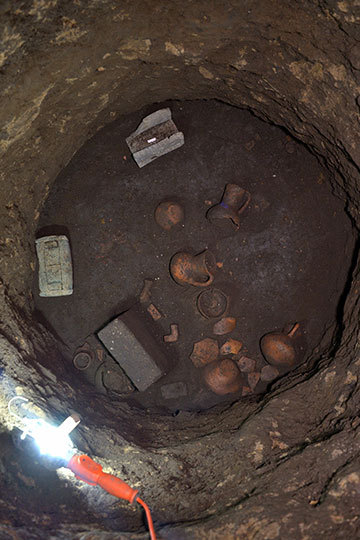
authors.elsevier.com/a/1QWlU15SlTUSMo

February 5, 2015

Possible 3000 Year Old Writing at the Peruvian Site of Checta

El Comercio Peru reports that there is strong evidence of writing at 2200 BCE at the site of Checta, a petroglyph site
3 hours from Lima. 500 petroglyphs at the site show images and motifs from four cultural periods. The second phase from 2200-1000 BCE could be writing. The same motifs appear over a wide area for 1000 years. The designs appear to be ideographs like ancient Sumerican writing. The site is endangered by new roads leading to a mine and hew housing. Pruvian officials have not been resposive to taking steps to preserve the site.
The Bradshaw Foundation has the report here;
http://www.bradshawfoundation.com/news/rock_art.php?id=Discovery-of-writing-at-Peru-s-Checta
And with a film and photos of the glyphs here;
http://www.bradshawfoundation.com/peru/index.php

January 28, 2015

Underwater Maya Temple Complex Discovered at Cara Blanca, Belize

Archaeologists are working at the Maya site of Cara Blanca in Belize. They have discovered an underwater temple complex. It appears that the Maya at this site were making hurried sacrifices to the rain god Chaak to stave off a continuing drought. Pots and bowls were thrown in by pilgrams coming here to pray for rain. Lisa Lucero is the lead archaeologist at the site, and has been investigating there for four years. Repeated droughts in the Maya realm eventually helped to bring the Maya kings down by 800 CE. The floors of the water temple were sprinkled with sacrificed potsherds and fossil teeth and claws. People also pulled out rocks and fossils from the bottom of the pools and cenotes to incorporate into above ground temples. Human sacrifices also took place in these pools.
National Geographic has the report here with nice photos;
http://news.nationalgeographic.com/news/2015/01/150127-maya-water-temple-drought-archaeology-science/

January 27, 2015

The Complex Rise and Fall of the Mesoamerican Metropolis of Cantona

Archaeologists researching at the Mesoamerican city of Cantona, occupied from 600 BCE to 1050 CE, was a large obsidian exporter. The population was at 90,000 at 700 CE. But between 900 CE-1050 CE, it was abandoned. The population expanded during a wet period from 600 BCE-50 CE, and continued to expand during a drier period from 50 CE-1150 CE. And it expanded further duting the most arid period, 500 CE-1150 CE. The expansion of the population was probably due to immigration from Teotihuacanos fleeing a collapsing Teotihuacan, the decline of Cholula and the eruption of Popocatepetl. The Cantona populace built more and more defensive works in its last 150 years, pointing to increasing turmoil. So the history of that great metropolis is a complex one involving both weather factors and social factors.
The research is published in the Proceedings of the National Academy of Sciences.  
Popular Archaeology has the report here with soke good photos of Cantona.
http://popular-archaeology.com/issue/june-2013/article/climate-change-and-the-rise-and-fall-of-a-pre-columbian-mesoamerican-city

January 22, 2015

Ancient Bone Surgery at Kuelap Fortress, Peru

A team of researchers studied two skeletons dated at 800-1535 CE at the site of Kuelap in Peru. Both had holes drilled in their legs. The placement and depth of the holes suggest this was done to relieve pressure from infection or injury, releasing built up fluids.
The research is published in the International Journal of Paleopathology
Peru This Week has the report here;
http://www.peruthisweek.com/news-evidence-for-ancient-bone-surgery-found-at-kuelap-105049

January 14, 2015

The Oldest City North of the Rio Grande Discoveries

Archaeologists are continuing to excavate at the East St. Louis site. This site is the oldest and largest city north of the Rio Grande. It preceded the site of Cahokia, and continued contemporaneous with Cahokia. It lasted as a large city for 150 years, and it was at its largest at 1000 CE. It is now becoming clear that it was bigger than Cahokia. Like Cahokia, immigration to the site was large. This could have been the result of a religious movement. Pottery from Southern Missouri, Northern Arkansas, Oklahoma, Texas and Wisconsin has been found there. As time went on, immigrants adapted the local pottery style. The Illinois State Archaeological Survey has uncovered 500,000 objects at the site. Arrowheads from North Dakota, Arkansas, Louisiana, Mississippi and Wisconsin are among the items. The number of arrowheads means warfare. And at 1200 CE, the site was abandoned. There is evidence of drought, which may have led to war.

The Pekin Times had the story here; http://www.pekintimes.com/article/20150212/News/150219646

January 13, 2015

Huge Offering at the Templo Mayor Analyzed

In May 2008, archaeologists found a large offering under the the statue of Tlatecuhtli at the Templo Mayor in Mexico City. Offering 126 had an assemblage of 4000 organic remains and 111 species. 40 from the Atlantic, 66 from the Pacific and some from rivers. 40 species came from as far away as the Gulf of Mexico, Florida, the West Indies, the Caribbean Sea, Venezuela and Brazil, and 66 from Baja California to Ecuador. Most of the material are mollusks, and it is clear that Aztec priests spent a lot of time gathering as wide and diverse collection of these to demonstrate the military and economic might of the Aztec empire. The findings are just being announced now.
Past Horizons has the report here;
http://www.pasthorizonspr.com/index.php/archives/01/2015/offering-to-goddess-reveals-reach-of-late-15th-century-aztec-empire

January 12, 2015

Ancient Snaketown, Arizona Pyrite Mirrors Came From Mesoamerica.

50 Pyrite mirrors were unearthed at Snaketown from the 1930s to the 1960s. They were found broken, burned and buried with humans in 16 graves. Ball courts, copper bells and macaw feathers were also found there. INAH began to study the mirrors intensely recently, starting in 2001. INAH found that the mirrrors were likely manufactured in central Mexico, each taking 110-160 days to create. They were worn by the elite as pectorals, belt ornaments, headgear. They were a portal to the underworld. The Snaketown mirrors date to 650-950 CE. The use of flakes of pyrite glued to sandstone with tree resin glue is a central Mexican craft. The Hohokam did not use pyrite. There are no Hohokam pyrite deposits.
Western Digs has the report here with a good photo;
http://westerndigs.org/mesoamerican-fools-gold-mirrors-found-in-arizona-reveal-ties-to-ancient-mexico/

January 12, 2015

The Oldest Human Skeleton Ever Unearthed in South America

An 11,230-12,401 year old adult male skeleton has been unearthed at Los Vilos in Chile. This is probably the oldest human skeleton ever unearthed in South America. This individual’s diet consisted of seafood, mainly fish and sea lions. He had serious gum infections and small wounds, and died at the relatively early age of 45. He suffered a common ear infection of seafarers. The place where he was found adds to the proof that the earliest Americans came by way of the sea. The archaeologists at the site have collected thousands of human bones. Bones of five other individuals within walking distance of each other have been found. The 11,230-12,401 year old skeleton was found in a mound, buried in a fetal position. And surprisingly, the five other individuals were buried in a different millennium, a thousand years later, in the same place. Donald Jackson, the lead archaeologist, submitted the bones for radio-carbon dating to three different labs in the US. He decided to publish the most conservative date of the three labs at 11,230 years.
(My Note; A little further down the Chilean coast, at Monte Verde, is the site of the first definite Pre-Clovis settlement. Much further north, at Paisley Cave, in Oregon, is the second positively dated Pre-Clovis site. By that, I mean human made tools dated at Pre-Clovis times, fibers, housing posts, human footprints, fishing implements, human coprolites, seaweed chewed on by humans, all dated at Pre-Clovis time periods, peer tested stratigraphy dating. Add to that the very old human remains found on the Channel Islands off the coast of California, and the evidence for a Pre-Clovis entry into the New World along the Pacific Coast by way of canoe traffic is now proven. The only way for humans to have reached coastal Oregon and coastal Chile in Pre-Clovis times was by way of canoe from Asia, hugging the coast from Siberia to the American Pacific Coast).
Que Pasa has the story (in Spanish) here;
http://www.quepasa.cl/articulo/ciencia/2015/01/3-16012-9-el-primero-de-nosotros.shtml
And Donald Johnson’s research on the site and the ancient individual is posted at Academia.edu as a re-print of his post in a peer reviewed journal here;
http://www.academia.edu/2040983/Human_remains_directly_dated_to_the_Pleistocene-Holocene_transition_support_a_maritime_diet_among_the_first_settlers_of_the_Pacific_coast_of_South_America

December 27, 2014

New Discoveries at the Old Vero Man Site may Yield Pre-Clovis Proof.

The Old Vero Man Site is being excavated in Florida anew in a large way. Radiocarbon dating of the soil that contained cultural materials and 170 species of plants and animals have been dated at 13,000-14,000 years ago. A buried soil layer has been dated at 19,000 years old. Burnt fragments of bone, some with cut marks, indicate a human presence at this Pre-Clovis dated site. Florida Atlantic University scientists are working with the archaeological team to confirm dates on any human artifacts that may be found at the site. Excavations will continue into 2015.

Heritage Daily has the report here with a very good film narrated by James Adavasio.

http://www.heritagedaily.com/2014/12/mai-dig-suggests-human-presence-old-vero-man-site/106062

December 10, 2014

Significant Wari Temple Excavated in Peru

An international team of archaeologists in Peru have uncovered an ancient Wari temple with a D-shaped temple and Wari influenced ceramics and textiles in southern Peru. The dig is uncovering material spanning 200 BCE-1000 CE. The Wari culture covered the south-central Andes from the highlands to the coast, with administrative centers, terraced agriculture and a huge network of roads. Excavations at the site will continue into 2015.
Popular Archaeology has the report here with good photos and a video;
http://popular-archaeology.com/issue/fall-09012014/article/archaeologists-excavate-ancient-wari-temple-in-peru

November 21, 2014

Groundbreaking Teotihuacan Mask Findings

New electron research into Teotihuacan masks reveals surprising proof that the iconic stone masks were made far from Teotihuacan and from materials that were not really jadeite. Researchers studied 150 of the 600 masks held in museums around the world. They found they were made from serpentine, travertine and limestone, and other softer stones and polished with quartz, which does not exist at Teotihuacan. They found 3 fakes among them. They now believe the masks were made by artisans in Puebla and carried to Teotihuacan. They were also able to source the microscopic remains of algae on the masks to identify their Puebla region origins.
Scientific American has the report here;
http://www.scientificamerican.com/article/electron-beam-points-to-origins-of-teotihuacan-stone-faces/

November 13, 2014

9,500 BCE Infant Burials Found at Upward Sun River in Alaska

Archaeologists from the University of Alaska at Fairbanks have uncovered the remains of an infant who died at 12 weeks and a fetus that died shortly before birth. The dates of these infants are at 9,500 BCE. The site would have been the area of Beringia during the last ice age. The site where they were found, at Upward Sun River, shows signs of long term occupation, including the oldest residential structures found in Alaska. Stone projectile points that made up a hafted biface spear, and antler rods were placed in the burials, and all were covered with red ochre. The infants may have been twins. Burials of children within residential structures have been found at the site of Ushki in Siberia, and the biface stone points are similar to those found at the Anzick site in Montana.
Science Magazine has the story here;
http://news.sciencemag.org/archaeology/2014/11/infant-burials-could-help-solve-mystery-who-settled-new-world
Western Digs adds that the antler shafts found in the burial are much longer then others found in North America, and are similar to those found in Siberia. Three of the shafts were covered in multiple X patterns, a new discovery in North American hunting tools.
The research is posted in the Proceedings of the National Academy of Sciences.
Western Digs has the report here with photos of the tools;
http://westerndigs.org/twin-ice-age-infants-discovered-in-11500-year-old-alaska-grave/

November 12, 2014

Child and Llama Sacrifice Uncovered at a Chimu Site in Peru

42 children and 76 llamas sacrificed by the Chimu Culture in Peru at 1400 CE have been uncovered by archeologist John Verano. The Chimu site is near the sea, so the children may have been sacrificed as a gift to the sea. The llamas may have been seen as guardians in the underworld.
Fox News has the story here;
http://www.foxnews.com/science/2014/11/02/mass-sacrifice-children-llamas-uncovered-in-peru/

November 5, 2014

Largest Pre-Columbian Site in Colombia Uncovered

Archaeologists have found a Pre-Columbian village in Colombia dating to 900 BCE-1500 CE. It is the biggest site ever found in Colombia. This discovery changes the idea that Pre-Columbian groups living aroud the area of Bogota were nomadic. Many of the artifacts found are of museum quality.
Colombia Reports has the story here with many good photos;
http://colombiareports.co/archaeologists-recover-remains-pre-columbian-village-central-colombia/

October 30, 2014

Stunning Teotihuacan Tunnel Finds

INAH archaeologists have been digging into tunnels below the Pyramid of the Sun for the last year. They have dug their way to the end of a 340 foot long tunnel and have found an entrance to a burial chamber. They have made their way two feet into the chamber. It will take a year to complete that dig. The tunnel was sealed off in 250 CE. They may find the grave of a Teotihuacan ruler in the chamber. A find that has eluded all archaeologists at the site since it began its excavation history.
PhysOrg. has a short report and many stunning photos of the finds so far, including large caches of conch shells and great and untouched Teotihuacan figurines.
http://phys.org/news/2014-10-mexico-archaeologists-explore-teotihuacan-tunnel.html
50,000 objects have been found in the tunnel including jade, shell, stone and pottery pieces, including pottery of a kind never before seen at Teotihuacan.
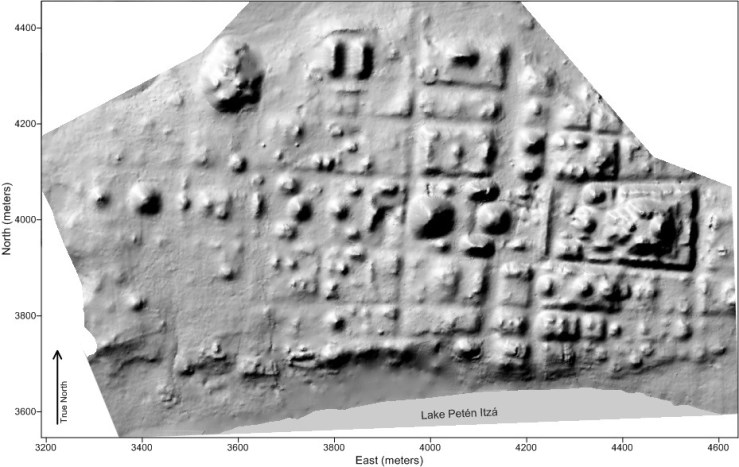
The Daily Mail has an even more stunning collection of beautiful photos of the objects in the tunnel and a video as well. The Daily Mail always has the best photographed displays of archaeological finds.
http://www.dailymail.co.uk/sciencetech/article-2813097/Filled-artifacts-ancient-Mexican-tunnel-lead-royal-tombs.html